How to think like a Futurist


No one can predict the future. What we can do is understand emerging technology, social patterns and economics to make sense of what might come next.

While my moniker is “Futurist”, my speaking agent once told me: “It’s better than ‘Technology Economist’, and you’ll get paid 10% more for each keynote.”

How to Approach the Future

In my 2017 book, The Lessons School Forgot, I talked about how AI voice assistants would radically improve. I even predicted that in five years, they wouldn’t just be a little better, but would have a PhD in every single subject, with the ability to understand everything humans do. Then ChatGPT arrived in late 2022 and could do exactly as I predicted.

My books and blog are filled with many accurate predictions of what technology would do. You can see an actual excerpt below.
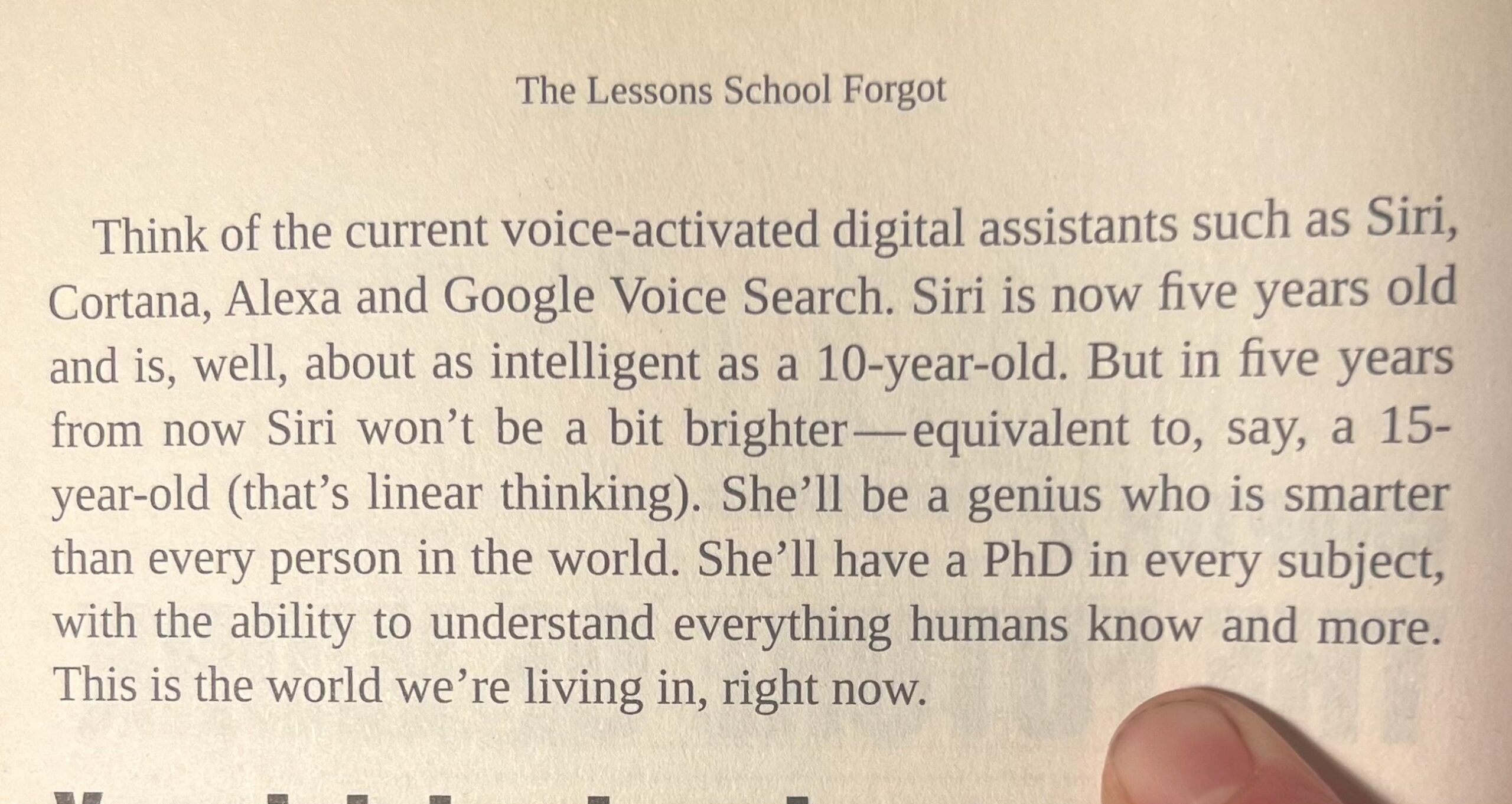
I saw the play, but not the early winner: ChatGPT.

Technology is predictable because it follows a particular pattern at an industry level. Players iterate on each other’s innovations as an unintended ecosystem collective. We also build what we imagine, and plan the future by all working on that possibility.

Who gets there first, though, is never easy to predict.

And predicting the winner isn’t that important unless you’re trying to pick stocks. Our job in business, and society for that matter, should be more about understanding what is likely to come next. What will technology make possible? Then we need to think about how this might affect our supply chain, where money flows, and how we get our share of it. Will it change our company, our industry, or even society? How should we react to this tech when it arrives?

Thinking about the future gives us a chance to respond more quickly when it arrives. And we can usually see what’s possible well ahead of time. I’m currently predicting humanoid robots will take the world by storm around 2030. While this will surprise most people, it really shouldn’t. The trajectory is clear.

But Tech Is Not Enough

Technology doesn’t tell the story of the future; it’s more of an ingredient. The future is always a mix of technology, human behaviour and economics. We need to mash these three elements together to see where society is heading.

Anthropology: Human behaviour doesn’t change much. We are running very old software as humans, DNA is a 400,000-year-old code base. Having a solid understanding of human psychology and our history is vital. We’re social creatures, and if something isn’t acceptable to the masses, it won’t change the business landscape, no matter how much a tech executive wants it to.

Economics: This is what ties technology and anthropology together. Unless the new tech is easy to substitute, with a good business model underneath it, it won’t be survive. Some things take decades; some happen quickly. The lower the switching costs, the quicker the adoption. This is why ChatGPT exploded to 100 million users in three months: it was super easy to go there, instead of Google.

As a Futurist, this is my “secret” template. It enables me to blow minds on stage during keynote speeches and provide future-proof strategy for any company, in any industry.

If you ever need help, you know where to find me!

Keep Thinking,

Steve.


The 7 Mega Trends of the Sovereign Era

Listen to Steve read this post below (15m audio)


Navigating the shift from From Global Markets to National Fortresses

Fortunes are made because they usually require big investment, the building out of infrastructure, and shifts in the geopolitical landscape. Fortunes are lost because of incumbents ignore these shifts because they take so long. During the build-out, bubbles often burst, allowing yesterday’s heroes to say, “I told you so…” before they eventually get usurped. Big Media missing the internet is still the best example.

The second most common question I get asked after a keynote is about big trends. And with that in mind, here are my top 7 big shifts—the shifts we’ve all got time to navigate around to adapt or start something new and big.

1. Deglobalisation

The era of hyper-globalisation is over. We’ve had three recent hits to remind us of the risks that come with the global marketplace. First Covid, then Trump’s Liberation Day Tariffs, and even the most recent war in Iran. The days of free trade are quickly being replaced with national-first focused policies. This doesn’t mean we’ll stop trading globally; rather, that global trade will retract. And it already is.

In the 1990s and early 2000s, global trade typically grew twice as fast as global GDP. In 2026, the WTO projects trade will grow by only 1.9%, while GDP is expected to grow by 2.8%. Global merchandise trade (the sum of world exports and imports) is now 44.8% of global GDP, down from its all-time high of 53.3% just over a decade ago. Remember, these shifts take decades. The good news is that this gives us time to recalibrate around them.

2. Re-shoring

We are moving from a “just in time” to “just in case” Economy. Manufacturing will return to high-cost labour markets. While Covid showed us the risks of international reliance, AI and robotics are about to remove the advantage developing markets currently have in manufacturing goods.

In the 1990s, the West literally taught China how to manufacture quality at scale. It was done via joint ventures from the promise of lower-cost goods to sell in home markets. Fast forward 25 years, and China has now surpassed the West in all forms of manufacturing. But the most important of these is humanoid robots. I’ve written about them before here, and I believe this shift is bigger than informational AI. I call it Physical AI—where we put brains into machines, especially human-shaped ones.

We quite literally need humanoid robots for two reasons. One, we don’t have enough humans; our global population has now turned the corner into decline based on global birth rates per female. Two, we have a human-shaped world. Houses, hospitals, and retail environments need flexible, dextrous robots who can do a task the first time they’ve seen it or literally had it explained to them. That’s coming quicker than we think. Expect to have humanoid robots which follow verbal and visual instructions with a PhD in every subject for around $30,000 by 2030. Yes, you’ll own one. And when this happens, we’ll get China’s robots to help make our robots and reverse what China did to the West, using their technology and processes to reinvent ours.

3. AI as Infrastructure

AI is no longer a feature, but a foundational utility of the 21st century. There are a lot of clues around this idea because at the same time we hear about huge amounts of investment (up to $7 trillion globally by 2030), we are also hearing rumblings about whether this will ever get a return on investment and people not wanting it built near where they live (all the while using Generative AI a zillion times a day). This is what has happened every time we’ve had large infrastructure shifts since industrialisation.

As of today, the investment in AI now rivals investment in roads and power grids. The US Interstate Highway System took 35 years to complete at an average annual cost of $18.8 billion; the AI data center build-out is currently spending that same annual sum every 5 weeks. It raises important questions about corporate power and ownership of the major factors of production. AI falls into that category and shouldn’t be in private hands. Smart countries will remove it from private operators, just like we did with the electricity grid in the Gilded Age.

4. Data is Energy

Big Tech is pivoting to becoming global energy titans; they have to in order to sustain the massive power requirements of AI. Google, Microsoft, and Amazon are securing their “compute” future by investing heavily in nuclear power, ranging from small modular reactors to reviving dormant plants like Three Mile Island. This shift blurs the line between information and physical energy, as AI data centers—already consuming 5% of the U.S. power supply—are projected to triple their demand by 2030.

This “Big Energy” move serves as a strategic “Monopoly 2.0” that allows tech giants to expand while avoiding antitrust scrutiny. By applying the Amazon Web Services (AWS) model to the power grid, these firms will generate excess carbon-free energy and sell it back to consumers, potentially displacing traditional utility and oil firms. This consolidation of AI, information, and infrastructure grants Big Tech a level of influence that rivals nation-states, positioning them as the new global colonizers of the 21st century.

5. The Conglomerate Comeback

There’s a reason Big Tech is doing so well in the share market. They remembered it is better to own than rent. And so, whenever they can, they use their excess funds to build or acquire the resources they need to expand. Outsourcing creates global shock risk. Building a giant supply chain in-house now fits with the emergent market dynamics listed above.

Take Amazon, for example: it didn’t outsource its supply chain—it bought every layer of it, then opened each layer up as a paid service to competitors. AWS was the template. Amazon owns 110+ cargo jets, 175,000 delivery vehicles, 1 million+ warehouse robots (via the Kiva acquisition), 185+ fulfilment centers, its own nuclear power plant, 450 satellites in orbit, and 500+ Whole Foods stores. This pattern is also evident in most of what Musk is doing, as well as Google. The most powerful companies of yesteryear did this too: in the 1920s, Henry Ford built a massive, pre-fabricated industrial town in the Amazon rainforest to secure a direct source of rubber for car tires. During the peak of globalisation, companies moved to focus on singular core businesses. That’s now in reverse.

6. Inequality as Policy

I’ll start with this: the world’s 12 richest billionaires now own more wealth than the bottom half of humanity (more than 4 billion people). It’s worse in the USA. Elon Musk has more wealth than the bottom 51% of the entire nation. The Gini coefficient is how economists measure inequality: zero indicates everyone has exactly the same wealth; a score of 1.0 means one person owns everything. The US is above 0.8 and in Australia, it is 0.61. It’s not your imagination—wealth is accumulating at the top. It’s why our economy lives in the extremes: people with 10 houses and people who can’t afford a house—or as I like to call it, the Tiffany’s and Costco Economy.

We can expect the government to start responding heavily with wealth taxes in addition to income taxes. They have to—otherwise, it will end in war, famine, or revolution; it always has. In Australia tomorrow, the new budget will be released with policies that hit inequality around investment properties and capital accumulation. But what we really need is a courageous government to go hard on corporate tax avoidance (easy to fix actually, just tax them on 5% of revenue), billionaires, and resources taxes. Even the CEO’s I work with of large public corporations agree who they work for should pay more tax – we all do.

I think and hope they are starting to get the message that they should chase the top end of town, not everyone somewhere in the middle trying to get ahead and secure a dignified retirement. The middle class was a great post-WWII invention and one that is worth maintaining. Globally, 74% of millionaires actually agree with increasing wealth taxes, as do I. Billionaires would do well to think the same way (be less greedy) if they want to remain at the top of the tree.

7. Re-nationalisation of Infrastructure

Smart governments are taking back the keys to essential services in the name of national security and resilience. The UK launched Great British Energy in 2025 with £8.3 billion in public capital to drive the clean-power transition. In France, the full nationalisation of EDF has allowed the government to cap energy prices and commit €72.8 billion to new nuclear reactors—the kind of long-term, nation-scale investment private markets were unwilling to make.

In Australia, it is mostly just rumblings—but a huge majority of voters want higher taxes on our fossil fuels, and public infrastructure back in the hands of “the public.” Simply because the jury is in: our services are now often worse and somehow cost more. Australia’s privatized services have evolved into a mandatory cost-of-living tax, with utility price increases consistently outstripping inflation. Electricity leads the surge with a 20% price hike following the “rebate cliff,” with electricity bills nearly five times the rate of inflation. The Transurban Tax evolves from a terrible deal where the government allows a fixed 4.25% escalation in prices per year. Meanwhile, corporatized water utilities have resulted in water prices doubling the inflation rate over the past decade. People are sick of it.

Now that people are aware of the heist, smart governments (let’s hope we get one) will claw back essential services, probably in a 51/49 private deal, so they can manage the cost of living and infrastructure investment, and provide employment and training enclaves.

Share

– – –

Keep Thinking,

Steve.


** Get me in to do a keynoteat your next event and as a blog reader – get 2 nights free at my luxury farmhouse on the Bellarine Peninsula.

What’s in the Museum of the Future?

20 Things You’ll See in 20 Years

Walk into a museum in 2045, and it won’t look like something from the past — it will look like today. It will reflect our homes, offices, and streets.

So many ‘modern’ technologies, ideas, and even social constructs are about to disappear — much quicker than we think. You might even find this a bit confronting, even unrealistic. But all of it is based on the technological possibilities of today… so buckle up.

Here are 20 exhibits you can expect in the Museum of the Future — and why they matter.

1. Physical Money

Remember coins and crumpled notes? They still exist… barely. The concept of cash will seem so antiquated — tokens and paper with pictures on them. Already, money is just numbers on screens and in databases. You’ll realise your kids have never even held money.

Supporting Factoid: Globally, physical money only represents 8% of the total supply of ‘cash’ people can make a claim on. In Australia, it is only 4% today.

2. Professional Drivers

Imagine a wall of steering wheels, gear sticks, and car keys. Videos of Uber drivers, truckies, and couriers — the last generation who steered their own destiny. Autonomous vehicles made this a job from history.

Supporting Factoid: Waymo (Google’s self-driving service) already has 1,500 cars operating in the USA, and they have a greater market share than Uber in every market they operate in.

3. Passwords

A light installation flashing millions of random characters — reminders of the era when we were the security system. Biometrics and passkeys made the “password” as dead as the rotary dial phone.

We are already halfway there…

4. Remote Controls

A giant pile of remotes in a Perspex box — all useless. Gesture, voice, and neural interfaces mean we control the world by thought.

5. Plastic Packaging

Mountains of crinkly wrappers and water bottles. Kids will gawk at the waste and ask, “You wrapped everything in this stuff?”

Supporting Factoid: Plant-based bioplastics are emerging quickly to replace plastic with all the efficacy, as well as being fully biodegradable.

6. Physical Screens

Thin LCD panels on the wall, smashed phones under glass. The exhibit will ask: “Why did we stare at rectangles for 12 hours a day when the world was all around us?”

Possible Replacement: Direct wiring into neural cortex!

7. Smartphones

A special section: the thing that made us gods for 10 years and slaves for another 20. The artefact that connected, distracted, and reprogrammed humanity.

Supporting Factoid: Smart glasses are emerging quickly as the most likely candidate to replace them. Meta’s latest iteration is quite impressive. But eventually contact lenses will win this race.

8. Tradespeople

Robot arms laying bricks and 3D-printed plumbing rigs. And humanoids doing any and every type of trade. You’ll watch footage of human tradies from the 2020s and feel nostalgic for the banter, not the cost.

Supporting Factoid: Humanoid robots can already be bought for around $16k. By the end of this decade, they’ll do everything people can — after being shown once, or downloading some ‘how to’ software.

9. Surgeons

Delicate metal scalpels suspended mid-air. The last human hands to open a chest cavity before precision robotic surgery took over.

Supporting Factoid: There were 14+ million robotic surgical procedures performed last year. And the first non-human-assisted trials are happening this year. Question: Would you rather a surgeon who has performed an operation 87 times, or a robot that’s done it over a million times in every context?

10. Actors & Directors

A wing filled with deepfake celebrities performing Shakespeare in every language. The final days of the Hollywood “star system,” when studios owned the faces and voices of the famous.

In the future, studios will mint new stars from AI that they own and control and don’t have to pay. Or even license our old favourites like Leo DiCaprio and Scarlett Johansson… while they stay home and watch Netflix.

11. The Internet

A blacked-out room with a dial-up modem screeching on loop. You’ll watch a screen to experience what “the feed” used to look like — and how it hacked our attention before decentralised, sovereign data grids took over, and bots took over.

Supporting Factoid: Just this year, the internet crossed over to more fake traffic than real human traffic. Humans are already exiting the internet.

12. Language Barriers

A globe that speaks every language at once. AI real-time translation made borders linguistic illusions.

Supporting Factoid: Many current smartphones and the latest Apple AirPods can already do this live.

13. Offices

Cubicles, water coolers, swipe cards. The last relics of “going to work.” In the future, work is a network — not a place.

The age of the digital craftsperson is already here.

14. Eyeglasses

A shelf of spectacles — quaint relics before gene therapy and nano-optics corrected sight at birth, or for us existential humans within the next decade…

15. Wheelchairs

A striking display of mobility aids that became obsolete once exoskeletons and neurotech restored motion to millions.

16. Forgetting

A poetic, slightly eerie space where visitors can choose to delete a memory — and then sit with the silence. In a world of perfect recall, the right to forget became sacred.

Question: Would you want to remember everything (childbirth?) or are some life experiences best forgotten?

17. Ageing

A time-lapse projection of faces getting younger again. Regenerative medicine turned ageing into an option, not a destiny.

Supporting Factoid: Live till 2035 and you’ll live forever… Read this if you haven’t already.

Would you want to liver forever?

18. Organic Humans

Yes, there will be a whole exhibit on “baseline humans.” No implants, no genetic tweaks, no cloud extensions. Just raw, analogue Homo sapiens.

We are merging with machines… rapidly.

19. Animal Farms

Screens of industrial animal agriculture — now gone — next to vats of lab-grown meat. These will be nature-identical down to the exact texture at the molecular level. A celebration of the end of animal suffering as a source of protein.

Confronting Thought: 50 years from now, killing an animal to eat it will be seen as worse than human slavery… Our grandchildren will be disgusted we ever killed and ate dead animals

20. Private Thoughts

A dark, intimate room where visitors sit in silence. It will be the most confronting exhibit: a reminder that once upon a time, your thoughts were yours alone.

Supporting Factoid: We are already reading people’s minds… I wrote about it here.


** Get me into do an AI keynote at your next event. I’ll use this as my testimonial!


The museum of the future won’t just display objects — it will display values. It will remind us what we lost, what we gained, and what we traded along the way. It won’t just be a walk through history. It’ll be a mirror — showing us who we chose to become.

Now consider the work you do or the company you work for… and ask yourself important this question:

Is it time to pivot to avoid the inevitable?


Keep Thinking,

Steve.

The AI Sovereignty Gap

It’s time to play offence – build a National AI Data Grid and sovereign digital capability.

Australia is the 14th largest economy in the world — but on Harvard’s Economic Complexity Index we rank a disgraceful 103rd. In fact, we currently rank behind Bangladesh, Senegal, and Uganda — a shocking reality for a top-20 economy.

Why? Because we’ve quietly become a giant housing Ponzi scheme with a mining habit.

We don’t have a homegrown search engine.
We don’t have a social network.
We don’t have a local browser or operating system, any meaningful digital platform — or anything serious in AI.

Honestly, every time you type @gmail.com it should be @auspost.com.au
No — this wouldn’t be hard. And yes — I trust our government departments more than I trust Google. (At least we can vote out a government.)

Seriously, we should build platforms at a macro level for private industry to leverage. It’s the smart play.

And while it’s easy to shrug and say, “We can’t compete with Silicon Valley,” the truth is we can. I don’t buy the narrative that we’re too small to matter. We have some of the best universities and educators in the world — we must, education is our third-biggest export (about A$21 billion in tuition fees alone). Global firms want you to believe only they can do this…. those running any show always do.

We have a deep local talent pool in tech and engineering.

What we lack isn’t resources or talent — it’s courage and leadership. A few decades ago, during the period of economic rationalism, we did something incredibly irrational — we stopped leveraging our abundant resources to build sovereign capability. And what got was houses no one can afford and cheap t-shirts.

What we need now is the ability to ignore the naysayers and actually compete. And honestly, whenever Australia has had a crack, we usually do quite well. Sports, the arts, and world-changing inventions (Wi-Fi, anyone?) are simple and informative examples.

We Used to Make Things

Once upon a time, Australia made cars, clothing, electronics. Manufacturing was everywhere — and when we did, equality ran deeper. Opportunity was broader. We gave more Australians a seat at the economic table.

Today, we export rocks, import iPhones, and hope for the best. Our most successful tech companies (like Atlassian) list overseas. And we wonder why our economy feels hollow.

Sovereignty Is a Choice

It’s not too late to rebuild — but we need to remember something important: We are sovereign.

Governments can set the rules. Companies — even trillion-dollar ones — will follow.

China did this with manufacturing and later, technology. They forced foreign companies into joint ventures, built capacity, and are now globally competitive in every industry, at every scale.

We could do the same at the dawn of this new AI era.

Infrastructure Over New Businesses

I don’t think Australia should try to launch government-run businesses. But we can provide infrastructure at scale that businesses can leverage as a tool.

This is what all the rich industrial countries in the West used to do: electricity grids, gas pipelines, roads and highways — but somewhere along the way, they lost the script. It’s time we found it again.

And the time is now — at the dawn of a new era. If we don’t, we risk becoming subservient to foreign tech powers, just as developing economies were to the West in the 1970s and ’80s.

Imagine This

  • Every hyperscale data centre built in Australia was partly government-owned, funded by the very big tech firms using it.
  • Or we built a National AI Data Grid — A$100B worth of GPU infrastructure — owned by the government and made open source for Australian startups, researchers, and entrepreneurs to tap into.
  • We let 1,000 flowers bloom, giving every clever mind in the country access to the raw compute power they need to build AI tools, platforms, and companies.

** Get me into do an AI keynote at your next event. I’ll use this as my testimonial!


Ignore the Naysayers

The AFR recently ran a piece saying it would be “crazy” for Australia to build its own LLM. I think it would be crazy not to.

Others say it can be done for under A$100M — and they’re right. But even if it cost A$10B, the long-term payoff in capability, exports, and independence would dwarf it.

The 21st Century Imperative

Australia can no longer rely on digging things up and selling them to the world. We need to build things again — digital things, and AI tools.

If we don’t, we stay stuck at the bottom of the economic complexity league table. If we do, we become the future-facing economy we like to imagine we already are.

Let’s stop renting the future from Silicon Valley.
Let’s own a piece of it.


Keep thinking,

Steve.

AI – Risk of Extinction

Listen to Steve read this post (8 min audio) – let me know if you listened instead of reading this!

Imagine for a minute you were given an investment opportunity which could be life-changing, enough to make you better off than you are now, maybe even seriously rich. But the price of entry was that you had to put every single asset you owned into it and there was a small chance it would go to absolute zero — even a 5-10 per cent probability that this would occur.

Would you do it?

I wouldn’t consider it, even for a second. Yet, these are the risks we are being asked to take with our live Generative AI experiment, at least according to some AI experts.

p(Doom)

If you think P(Doom) sounds worrying, trust your instincts. P(Doom) is the term AI researchers are using to describe the probability that Artificial Super Intelligence will emerge and become an existential risk for humanity. (What a wonderful little moniker.)

Here is the crazy thing. Many learned AI researchers now have this probability sitting as high as 20-50 per cent. Kinda scary. Even a 5 per cent chance to wipe out our species is a worry… and there is almost no one who has a ratio smaller than this. Sam Altman, the CEO of Open AI, who created ChatGPT, has publicly said the risk is real and he has a P(Doom) at around 5 per cent.

It’s at this point that we must remember that we are not talking about something bad happening here, like, say, a recession, or a war, a hurricane, or even a pandemic. All of these we’ve faced before and, with a lot of pain, have overcome, collectively. We are talking about the end of humanity – it doesn’t get any heavier than that.

  • Reply to this email and tell me what if AI worries you.

Says Who?

Some of those with a P(Doom) at worryingly high levels are not fear-mongering crackpots, but those deeply involved in giving birth to AI. Here are some of the worried AI researchers and their P(Doom) percentages.

  • Michael Tontchev, a former Microsoft software developer and current senior software lead at Meta has his at 20 per cent.
  • Paul Christiano, a former OpenAI researcher who also holds a Ph.D. in theoretical computer science from UC Berkeley has his at 50 per cent.
  • Eliezer Yudkowsky, a renowned AI researcher and decision theorist has his at 50 per cent.
  • Geoffrey Hinton, known as the godfather of AI and a recent Google employee has his at 50 per cent.

Cold War 2.0 & AI Bunkers

As a keynote speaker on the future and AI, the most common question i get asked is if we will face a ‘Terminator Moment’. And just like at the height of the Cold War, those with their fingers on the button seem to be the only ones with a bunker they can run to if things go wrong.

In 2016, Altman said in an interview he was prepping for survival in the event of catastrophe such as a rogue AI, claiming to have guns, gold, potassium iodide, antibiotics, batteries, water, gas masks from the Israeli Defence Force, and a big patch of land in Big Sur that he can fly to.

Altman’s doomsday vision of AI gone wrong is not uncommon in Silicon Valley. No tech billionaire worth his salt doesn’t have a post-apocalyptic contingency plan and remote bunker. Both Peter Thiel and Google co-founder Larry Page have snapped up land in New Zealand and built bunkers. They literally have private jets filled with fuel – which they don’t use – and pilots paid to wait for this ‘nuclear moment’.


This is some feedback I got from a client on my  my new Keynote on AI  – 

“Steve was amazing, awesome and all the superlatives. His insights on AI were absolutely incredible as was the feedback from our customers.”

It’s a revolution – Get me in – Don’t miss out!  


The AI Saviour?

Readers will know that I’m typically positive when it comes to the emancipating power of technology. And the last thing I want to be accused of is fear-mongering. There is a counter-argument to the worries about the AI threat:

We may not be able to survive without it. Really.

It seems to me that the probability of our species surviving other existential risks is greater than most experts’ AI P(Doom). The nuclear threat is still very real, and possibly greater than it ever was during the Cold War. While we theoretically control it, we can only count ourselves lucky that a crazed suicide bomber or rogue terrorist group hasn’t secured and deployed nuclear weapons.

Likewise, despite our progress with renewable energy, I can’t see progress by any large nation-state, which gives me the confidence to believe we can reduce our global emissions to the level needed before we reach a point of no return. We are still largely addicted to fossil fuels, GDP, economic growth, and consumption.

Maybe the thing we actually need is an all-omniscient, benevolent AI to save us from ourselves!

An AI which can uncover new forms of yet-to-be-discovered highly available energy, or ways to ensure we circumvent nuclear disaster via ‘Artificial Diplomacy’, an AI which can help us navigate species-level dangers which are already clear and present.

Keep Thinking,

Steve.

AI – Merging with Machines

Listen to Steve read this post (4 min)

The debate is heating up on Artificial Intelligence. Many experts believe that we’ve created AI which is close to becoming self aware. If that is true, we only have one choice.

We must merge with the machines.

If we don’t do this, we may lose our status as the alfa species on the planet. Machine Intelligence Researcher, Eliezer Yudkowsky believes we are in a very bad position and things could get radical quickly. While no one knows for sure, he has a deep, interesting and scary discussion about the issue here.

It’s Evolution Baby

Here is what I know for sure. Every species that exists today, evolved from something else. AI, is something we’ve literally given birth to. Not via traditional, biological methods, but we created it nonetheless. It is the child of a biological being – us. We have used our biological intelligence, and created it from natural substances on earth. Everything on earth is natural.

It may just be that we are subconsciously, as a species, configuring a way to evolve much more quickly outside of our bodies, before work out a way for the AI technology to enter our bodies. And eventually allow it to interact with our wet-ware. If we do this, and I think we will, it won’t be us versus the machine, we will become the machine. In time, we’ll work out a way to breed with it inside our progeny. It feels to me like part of the natural evolutionary process. I wrote about this inevitability 6 years ago.

Get me to deliver my new Keynote on AI  I discuss our species merging with machines & what it means for your organisation. Make your next conference one to remember!

A New Species… and Podcast

If or when this occurs our species will split. We’ll have NEO Humans (tech-enhanced) and Luddite Humans (bio-beings). It’ll be a bit like some of the chimpanzees who decided to climb down from the tree, walk on two legs, and cross the Savana. Some will adapt, and some won’t. That moment is approaching quickly.

I discussed this issue in detail on my new Podcast ‘The Futuristic’. I have two co-hosts – one is a generative AI we’ve built, called Sailli (pronounced ‘Sally’). She interacts with us in the podcast. We even created her a fake face – she is below.

You can listen and subscribe here.

I’m also doing the Podcast with Cameron Reilly who is one of the smartest people I’ve ever met (not as smart as Sailli though). And we all disagree often. Our goal is simple, to go deep on tech. To go beyond the headlines, and uncover if we’re living the Jetson’s style future we were promised. It’s a great listen – get on it. We’ll be iterating the format as we go.

Be sure to email me back and tell me what you think about merging with the tech. I always love to hear your thoughts.

Keep Thinking,

Steve.

How A.I. just changed the Internet

Welcome to 2023 – This year I’ve promised myself to post here every Friday – starting today of course.

The impact of ChatGPT has been well documented in the media. If you haven’t played around with it yet – then I strongly suggest you give it a whirl.

There have been many articles about which industries and jobs ChatGPT might disrupt. Here’s a much simpler way to look at it from the Sammatron: If your job or industry uses ‘words’ – it will be impacted.

It’s that simple. It will impact everything. Like the internet that came before it, ChatGPT brings inordinate opportunities for those who choose to embrace the new reality.

The internet is currently:

A Giant Filing Cabinet

Everything we see on the internet is made by someone, somewhere. Words, pictures and video, all of it. Our experience on the internet is basically asking services to find and serve up what we’ve subscribed to or what we’ve searched for in this giant filing cabinet of human creation. Even when it is live, it’s still us peering in the window of what someone else is making or doing. This is why search and social are so powerful. That’s about to change.

We are about to go from Search Engines to Creation Engines.

(Read the above sentence again, it’s that important)

Let me explain. Starting now – we will shift from asking the internet to find what we want to asking it to create what we want. We’ll be expecting it to answer exact questions to queries, summarise things, write for us, create images, pictures, stories, animations, rap songs and even write software code for us by literally asking it to create an app that does XYZ. We are about to see another level of technology democratisation beyond what anyone can imagine.

ProTip: Get me to come into your company and deliver my mind blowing new Keynote Speech on How AI is about to change everything.

The art of the internet will rely on our ability to work with Artificial Intelligence. We’ll need to cajole the AIs to create what we are after. We’ll need to become great at prompting and teaching AIs how to build what we desire, because when used correctly, AI should be a mind expanding tool. An addendum to our biology, not a replacement. We’ll need to learn how to literally ‘train the AIs’ like we might a train a dog. It will be about the symbiosis of using tools. From a business perspective, our attention should be focused on industries that can cut costs through large language models and AI-generated imagery. The business of words and images will have production costs cut dramatically.

Get Daily Inspiration on my Tik Tok – 4 million views & counting! – Follow me here

Our imaginations on what to ‘make’ will become increasingly important. Here’s a prompt we might give very soon: “Create a seven minute animated movie, in manga style. Let it star a seven year old girl named Mary (base her animation on this picture) and her magic pony, who saves the world from a climate crisis. Give me versions in English, Spanish and Mandarin.”

As  I’ve previously written, the ability to determine what was made by a human or a machine will be increasingly difficult to differentiate. Likewise, an entirely new species of startups and business opportunities will emerge. It’s early, so it’s time to get started.

– – –

Keep Thinking,

Steve.