No one can predict the future. What we can do is understand emerging technology, social patterns and economics to make sense of what might come next.
While my moniker is “Futurist”, my speaking agent once told me: “It’s better than ‘Technology Economist’, and you’ll get paid 10% more for each keynote.”
How to Approach the Future
In my 2017 book, The Lessons School Forgot, I talked about how AI voice assistants would radically improve. I even predicted that in five years, they wouldn’t just be a little better, but would have a PhD in every single subject, with the ability to understand everything humans do. Then ChatGPT arrived in late 2022 and could do exactly as I predicted.
My books and blog are filled with many accurate predictions of what technology would do. You can see an actual excerpt below.
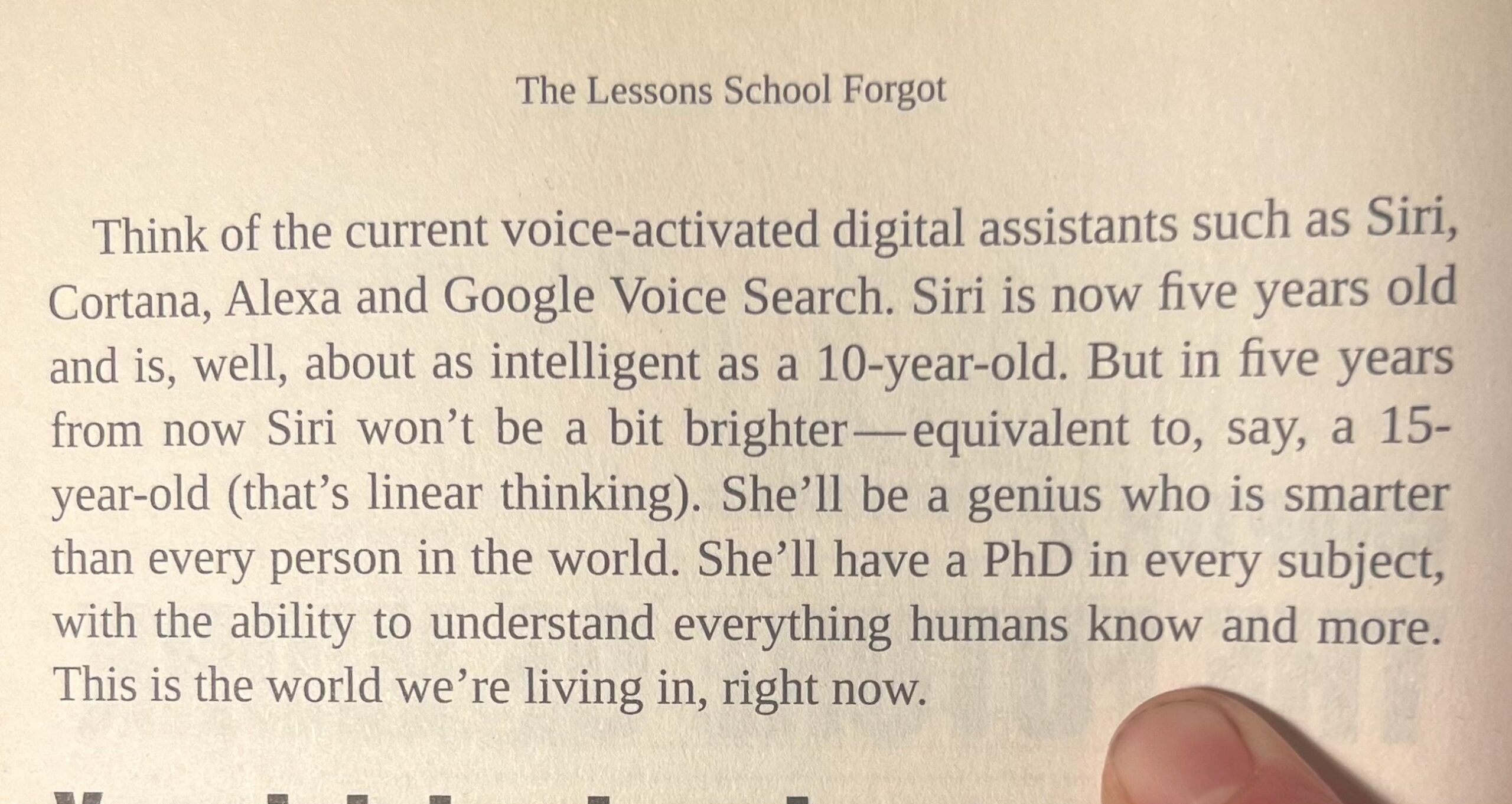
I saw the play, but not the early winner: ChatGPT.
Technology is predictable because it follows a particular pattern at an industry level. Players iterate on each other’s innovations as an unintended ecosystem collective. We also build what we imagine, and plan the future by all working on that possibility.
Who gets there first, though, is never easy to predict.
And predicting the winner isn’t that important unless you’re trying to pick stocks. Our job in business, and society for that matter, should be more about understanding what is likely to come next. What will technology make possible? Then we need to think about how this might affect our supply chain, where money flows, and how we get our share of it. Will it change our company, our industry, or even society? How should we react to this tech when it arrives?
Thinking about the future gives us a chance to respond more quickly when it arrives. And we can usually see what’s possible well ahead of time. I’m currently predicting humanoid robots will take the world by storm around 2030. While this will surprise most people, it really shouldn’t. The trajectory is clear.
But Tech Is Not Enough
Technology doesn’t tell the story of the future; it’s more of an ingredient. The future is always a mix of technology, human behaviour and economics. We need to mash these three elements together to see where society is heading.
Anthropology: Human behaviour doesn’t change much. We are running very old software as humans, DNA is a 400,000-year-old code base. Having a solid understanding of human psychology and our history is vital. We’re social creatures, and if something isn’t acceptable to the masses, it won’t change the business landscape, no matter how much a tech executive wants it to.
Economics: This is what ties technology and anthropology together. Unless the new tech is easy to substitute, with a good business model underneath it, it won’t be survive. Some things take decades; some happen quickly. The lower the switching costs, the quicker the adoption. This is why ChatGPT exploded to 100 million users in three months: it was super easy to go there, instead of Google.
As a Futurist, this is my “secret” template. It enables me to blow minds on stage during keynote speeches and provide future-proof strategy for any company, in any industry.
If you ever need help, you know where to find me!
—
Keep Thinking,
Steve.