Fake Drake and AI Twins

Listen to Steve read this post (9 min audio)

An AI-generated song purporting to be Drake and the Weeknd caused a stir in the music world after going viral and accumulating over 20 million views on streaming and social platforms. Called ‘Heart on my Sleeve’ track was originally posted on TikTok by a user called Ghostwriter977.

Universal Music Group (UMG) promptly had it removed from almost everywhere, though it can still be found, with some digging. The label condemned the song for “infringing content created with generative AI.”

“The training of generative AI using our artists’ music begs the question of which side of history all stakeholders in the music ecosystem want to be on: the side of artists, fans, and human creative expression, or on the side of deep fakes, fraud, and denying artists their due compensation,” UMG said.

Copyright Claim

What’s interesting is that the video was blocked on YouTube with the note:  “This video was blocked due to a copyright claim by Universal Music Group.” But how can Universal Music Group own this? They didn’t create it; it is an original composition by GhostWriter977.

Unless they literally own Drake’s voice or everything he represents, it seems like a battle is underway. For those who say Generative AI will put lawyers out of work, I say: not yet!

I see an industry in panic mode.

The last time the music industry panicked, it didn’t end well. It took them over a decade to pivot to the new reality and in the meantime, they handed over the lion’s share of profits to big tech through iTunes, YouTube and, eventually, Spotify.

The genie is out of the bottle, and putting it back will be impossible, especially when we can create fake versions of any artist’s voice, style, or face with no discernible difference.

Embracing A New Reality

The artist Grimes took a completely different path. Grimes, real name Clare Boucher, probably best known as the former partner and parent of children with Elon Musk, has embraced this new trend. She has given permission to use her voice with AI to create new music but with the condition that she receives 50 per cent of the royalties generated by any work.

When it comes to technology, protection never works, especially once it is democratized. Technology is like water; it always finds the leaks. The long game here will be licensing and new platforms.

Grimes has even launched a new AI voice software called Elf-Tech to help people duplicate her voice to create new music. The platform allows users to upload recordings of their own voice, which can then be transformed into a Grimes-like style using automated technology. These vocals can be mixed with electronically generated sounds and beats to create tracks that closely resemble her work.

Boucher’s high-pitched ethereal voice and rave-vibed tracks already sound very computer-generated, so it’s not surprising that she has embraced this concept. According to Boucher, this is the future of music: if you’re an artist, you let an algorithm replicate your voice, then you cash in for a percentage of the profits.

Get me to deliver my new Keynote on AI  – and I’ll lay out exactly how AI is about to impact your industry & company. You won’t regret it.

A World of Bio-Twins

In tech, we have something called an API – it stands for Application Programming Interface. It is when a tech company opens up part of its software for other companies to integrate into their own software. The two pieces of software can then interact and create new functionality. Powerful platforms often provide their software through APIs. For example, when you see Google Maps inside another site, that site is using an API.

Now, people will have their own APIs. Let’s call it a Bio-API. It will be a place where you can download an AI version of someone’s ‘voice’ or ‘face’. Once you have this copy of their biological likeness, you can use it to create new sound or video content.

Many people will have AI Twins that others can use to create content as if it were that person, but it will be AI-generated. In the new world, personal brands are far more than ego – they may just become platforms.

A New Industry

With Grimes opening Pandora’s Box, we can expect other artists, actors, and creators to enable platforms to create ‘fake’ but new AI versions of themselves or their styles.

I expect new creator platforms to emerge where new music and art can be created using virtual files of any artist you choose. These platforms will include music styles, voices, and every AI tool you need to create a new Nirvana album with lyrics Kurt Cobain never sang, (like him sInging Black Hole Sun here) sounding exactly like him, or a Beatles song with John Lennon. Here’s John Lennon singing Karma Police by Radio Head) Current and emerging artists may also be featured.

Smart artists will let creators work and share the rewards. Who wouldn’t want an entire population working for them, leveraging their bio-prints? Those who try to protect against this will lose, as they always do.

From a platform perspective, one or two singular platforms that everyone gravitates towards will become new big tech players. And just like that, AI will spawn an entirely new industry.


Keep Thinking,

Steve.
AI – Merging with Machines

Listen to Steve read this post (4 min)

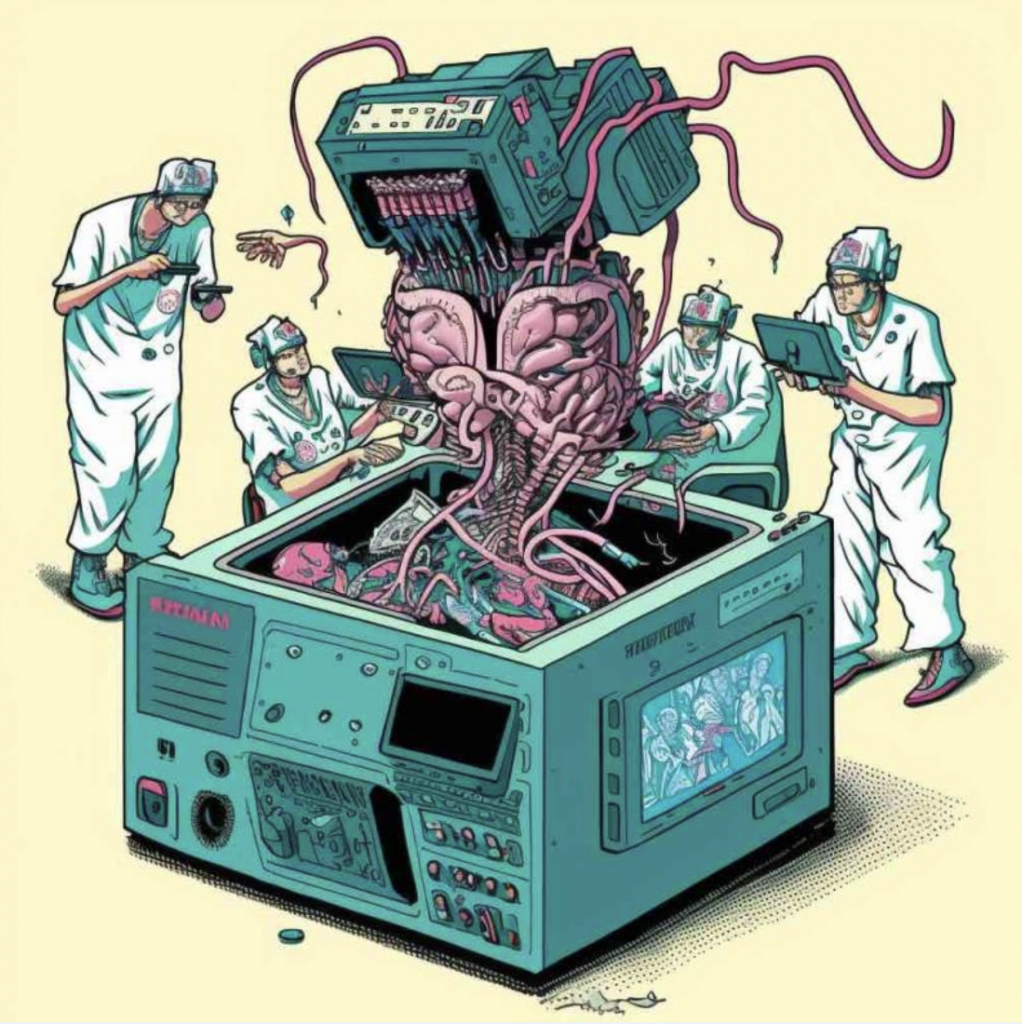
The debate is heating up on Artificial Intelligence. Many experts believe that we’ve created AI which is close to becoming self aware. If that is true, we only have one choice.

We must merge with the machines.

If we don’t do this, we may lose our status as the alfa species on the planet. Machine Intelligence Researcher, Eliezer Yudkowsky believes we are in a very bad position and things could get radical quickly. While no one knows for sure, he has a deep, interesting and scary discussion about the issue here.

It’s Evolution Baby

Here is what I know for sure. Every species that exists today, evolved from something else. AI, is something we’ve literally given birth to. Not via traditional, biological methods, but we created it nonetheless. It is the child of a biological being – us. We have used our biological intelligence, and created it from natural substances on earth. Everything on earth is natural.

It may just be that we are subconsciously, as a species, configuring a way to evolve much more quickly outside of our bodies, before work out a way for the AI technology to enter our bodies. And eventually allow it to interact with our wet-ware. If we do this, and I think we will, it won’t be us versus the machine, we will become the machine. In time, we’ll work out a way to breed with it inside our progeny. It feels to me like part of the natural evolutionary process. I wrote about this inevitability 6 years ago.

Get me to deliver my new Keynote on AI  I discuss our species merging with machines & what it means for your organisation. Make your next conference one to remember!

A New Species… and Podcast

If or when this occurs our species will split. We’ll have NEO Humans (tech-enhanced) and Luddite Humans (bio-beings). It’ll be a bit like some of the chimpanzees who decided to climb down from the tree, walk on two legs, and cross the Savana. Some will adapt, and some won’t. That moment is approaching quickly.

I discussed this issue in detail on my new Podcast ‘The Futuristic’. I have two co-hosts – one is a generative AI we’ve built, called Sailli (pronounced ‘Sally’). She interacts with us in the podcast. We even created her a fake face – she is below.

You can listen and subscribe here.

I’m also doing the Podcast with Cameron Reilly who is one of the smartest people I’ve ever met (not as smart as Sailli though). And we all disagree often. Our goal is simple, to go deep on tech. To go beyond the headlines, and uncover if we’re living the Jetson’s style future we were promised. It’s a great listen – get on it. We’ll be iterating the format as we go.

Be sure to email me back and tell me what you think about merging with the tech. I always love to hear your thoughts.

Keep Thinking,

Steve.

AI – Our New Overlord?

Click below to listen to Steve read this post (11 min audio)

I remember pundits exclaiming the personal computer, the internet and the smart phone would change the world. And they did….

But, this is the first time I can remember new tech being discussed as an existential threat to our species.

Recent developments in Large Language Models such as ChatGPT are significant enough that some of the world’s most qualified researchers are making a plea for us to stop before things spiral out of hand.

A Rare Event

An Open Letter published by The Future of Life Institute requested we put the brakes on all AI research. This is a rare event. From recent memory, we’ve only ever had moratorium on human cloning, and germ-line modifation.

This time, they are less worried about the modification of our species and more about creating another ‘species’. One which superior to us in every measurable way.

As a long-time technologist, I think it would be prudent to take heed of the letter. But first, we all need to understand the different types of AI, what they mean and what they can do, as most people lack this context.

Today’s post is an important explainer.

Types of AI

At its simplest, Artificial Intelligence is a field which combines computer science and robust datasets to enable human like problem-solving. AI is achieved by creating algorithms that are capable of learning from and adapting to data and experiences.

It’s different to industrial machinery, as the software uses AI to ‘think’, like a human and perform tasks on its own. The AI chooses what to do, based on a set of instructions. A machine simply performs a pre-determined task upon instruction.

There are 3 clear types of AI’s:

  • Artificial Narrow Intelligence (ANI)
  • Artificial General Intelligence (AGI)
  • Artificial Super Intelligence (ASI)

Artificial Narrow Intelligence: ANI represents the large majority of AI’s we use in modern society. These are generally rule-based AI’s which decide something based on an ‘If This, Then That’ Protocol (IFTTT). A simple example of this is would be Google maps which generate for you the quickest way to get somewhere based on distance, traffic conditions and estimated traffic conditions during the journey. A self-drive car also operates under this doctrine. We could even add image recognition, and deep fakes to this list. They are described as narrow because they typically operate in a vertical. The only context they have is within a specific framework. These AI’s do improve, iterate and learn, as their dataset gets bigger. But they are limited to a specific realm. While most of these ANI’s outperform humans, they lack nuance, are imperfect and can’t really be applied to different tasks.

Artificial General Intelligence: ChatGPT falls into this description and is the reason why people are becoming concerned. AGI’s take intelligence and make it horizontal, meaning they can be applied to a number of, and potentially unlimited, contexts – much like biological beings. An AGI is capable of performing any intellectual task a human can. Such systems can reason, learn, plan, understand natural language, recognise patterns, and solve problems. This is what Large language Models can do, and the reason they can do it is that they’ve learned via the entire gamut of human experience, in what is our species’ killer app – Language. All they need is the correct input. AGI is intended to be a more flexible and adaptable form of AI. It can understand new situations and environments. AGI systems are capable of generalising knowledge and taking skills from one domain and applying it to another. Already, ChatGPT has shown a number of emergent capabilities and intelligences it was not designed for. These were surprises to the developers themselves. The fear is this will lead to self-awareness.

Artificial Super Intelligence: ASI’s are different, and the major risk we face as this ‘unauthorised’ AI experiment continues. It refers to a hypothetical form of artificial intelligence that surpasses human intelligence in every way and is capable of designing and improving its own systems, even beyond human comprehension. It has the potential to develop its own objectives, agendas, and organise the factors of production for its own purposes. It can go beyond instruction and become a new form of living entity, which can spawn new improved versions of itself, and even organise hardware to build out any physical manifestations of itself, which it may require to perform tasks against its own desires – whatever they may be.

ASI is considered the ultimate form of artificial intelligence, and could potentially revolutionize, or end civilisation as we know it.

Didn’t mean to scare you.

Your business should be scared of AI – only if it doesn’t get me in to deliver my mind blowing new Keynote on AI  – it’s a game changer.

The Singularity

The idea of the Singularity, as proposed by Ray Kurzweil, is based on the concept that once ASI is achieved, it would rapidly accelerate technological progress and fundamentally transform human civilization. According to Kurzweil, the Singularity would mark the point at which technology becomes so advanced that it is no longer possible to predict or comprehend the future. Kurzweil believes that this is both inevitable and irreversible — He currently predicts this will happen by 2045.

Externalities

Humans are typically slow to respond to externalities. This was true with climate and fossil fuels. But we didn’t realise carbon emission posed a threat until fossil fuels were ensconced in the modern economy. This is not one of those times. If Kurzweil is right, global temperature could be the least of our worries.

The biggest challenge is that we live in an era of democratised technology. No one needs government approval to commence their own AI development lab. No oner needs Manhattan Project style budgets. But the implications could be ‘nuclear.’ In addition, our geo-political environment is one in which we can be sure the Chinese Communist Party won’t press pause on AI, even if democratic countries do. 

While it could be that we never generate an ASI (I’m still waiting for my fully autonomous vehicle) this is a time when prudence is desirable. As the Open Letter mentions, the last thing we want is unelected tech leaders putting our civilisation on the line. What I’d much rather is courageous leaders using the powers they’ve been granted to make decisions no individual can.

Keep thinking,

Steve.

Disrupting Google

Business disruption is not caused by technology alone. For it to occur we need 2 things to arrive simultaneously.

(1) A new technology

+

(2) A new business model

If we only have one, the incumbents can usually adapt. They can plug the new tech into the existing business model. Or, they can revert the old technology into a new business model.

For example:

The Music Industry had 3 new technologies before they got disrupted. They had the phonograph, the tape and the CD. Each time they sold the new tech in the old business model. It wasn’t until the mp3 arrived until the industry changed. When that happened, the business model shifted with the tech, which resulted in disruption: Napster (stealing music) and Apple iTunes (buying music one song at a time). Then when streaming arrived, a further disruption occurred as both the tech and business model shifted once more. No one buys music, they subscribe to it.

Likewise, when the Airline Industry had low cost airlines arrive. A new business model emerged, but because it was utilising existing technology: planes, airports and booking engines, legacy players could plug in low cost sub-brands. No real industry disruption transpired.

Most Successful Consumer Product Launch in History

Chat GPT is the fastest-growing consumer product in history. It had over a million users in its first week and more than 100 million in two months. Previous technology juggernauts haven’t come close: TikTok took nine months to get to 100 million users, Instagram took nearly three years and Google took nearly two years to reach this milestone. It isn’t just the rapid growth of users of the platform that’s interesting. It’s that it demands a review of internet Search as we know it, how we perform searches literally and the resulting business model which underlies it. It may even redirect us away from advertising and the prevailing surveillance capitalism model.

The technology and business model just changed for search. Sounds crazy to say it, but Google could be in trouble. If there was ever a company which looked dominant and unstoppable mere months ago, it was Alphabet. Their Google search engine commands a 90%-plus share in most of the markets it operates in. Then along came ChatGPT.

Will your company be the Disrupter or the Disrupted with AI ? Get me in to share my mind blowing new Keynote Speech – and win in the new AI era.

Bing v Google

At the moment it looks like Open AI, the developers behind ChatGPT, have everything to gain, but behind the scenes is tech overlord Microsoft. If all goes to plan they could be the unexpected winner in AI, and there are literally trillions of dollars in market capitalisation at stake. Microsoft’s 23 January $10 billion investment in Open AI may well be the tech deal of the century. As a part of it Microsoft will have exclusive access to Open AI’s product suite, and will gain a 49% share of Open AI. However, Open AI will need to give back Microsoft 75% of the profits until Microsoft recoups its initial investment. Microsoft have already plugged ChatGPT into their Bing Search engine, and it is pretty damn good. I’ve switched already. But is isn’t just the product which puts google at risk, it’s the costs and business model.

The cost per ‘prompt’ on ChatGPT is currently around $0.02c. This is vastly more than the $0.00001 per Google search, and probably couldn’t support a pay per click or display advertising model. The recent option to subscribing to ChatGPT for $20 per month is a clue as to where the business model of Generative AI is likely to go – subscription rather than advertising. This would both remove the ‘free rider’ problem, and temptation to compromise product quality to appease the advertising model supporting it. Subscription is also needed because AI is far too expensive per prompt to run a pay per click model. This is a major problem for Google – which people use for free.

The market is likely to bifurcate into two segments: Search (Traditional web links) and Creation (Generative AI).

Think about it – if we shift our search habits to ask questions and getting an actual answer, rather than a page of links and options – the pay per click model could die alongside it. Bing might just become the world’s first Premium Search engine – a pay to play for a different kind of search.

The Code Red which was called in through halls of the GooglePlex hasn’t resulted in anything that seems like a worthy response to ChatGPT. After a failed demo last week of the Google AI chatbot Bard, it lost more than $100 billion in market cap. But I also wonder if the market senses that Google has far more to lose even if (and most likely when) it develops a competitive AI product. 58% percent of Alphabet’s revenue comes from search, which is driven by pay per click advertising, which simply can’t survive with generative AI – there are literally no clicks when you get a direct answer. Currently Microsoft only generates 5% of its revenue from Bing pay per click advertising. In real terms, it has a potential ten-fold search revenue upside, with near zero downside all the while potentially adding a new weapon to its already strong enterprise offers of Windows, Office and Azure. AI inside your own laptop, generating answers from your own personal data. That would be super powerful, personally and at an enterprise level.

Just when we thought we thought a one tech firm could never be usurped, a new technology comes along which potentially changes everything.

– – –

Keep Thinking,

Steve

Robotic Love

Recently it was my daughter’s birthday. So I decided to write a poem about her as a gift.

Here it is:

Flora, a girl with a heart full of dreams. Turning thirteen, her future beams.

With a book in hand, she loves to read. Fantasy worlds, is where she likes to lead

Writing stories, her imagination flows. Creating characters, she knows and chose.

Drawing pictures, her talent is true. Artistic skills, she’ll always pursue.

Learning new things, her curious mind. Expanding her knowledge, she’s one of a kind.

With family by her side, laughter and cheer. Making memories, she holds dear

Playing piano, her fingers glide. Melodic notes, her heart resides.

Guitar sessions with dad, a special bond. Music brings them together, and beyond.

As she grows, her passions will bloom. A bright future, she’ll soon assume.

Happy 13th birthday Flora , keep shining bright – May your dreams take flight.

Of course, you already guessed that this was written by ChatGPT.

I’ll admit it isn’t the worlds greatest poem, I’ll call it serviceable, and better than I’d write. This is the prompt I gave ChatGPT to come up with it: “Make a poem, Make it rhyme. Let it be about a girl turning 13 whose name is Flora. Include the following topics; reading, writing, drawing, learning new things, hanging out with family, playing piano, having a guitar session with dad”.

So, I read this out to my daughter, who really likes it, and is quite emotional. She says; “It’s so beautiful! How long did it take? When did you write it?” I say; “Just now, took me about 30 seconds to generate using ChatGPT…”

Bonus: Free Interview of me talking about how ChatGPT works and if Skynet has arrived!

My daughter went from being moved to pretty disappointed. The poem hadn’t changed, just ‘where it came from’. She told me she liked it because I did it, not the words, and went on to say, it’s just not as good anymore. This is what we ought remember.

I knew this would happen, but I really wanted to see a real human reaction to Robot Love. (FYI – I wrote her something myself as well which I’ll keep private – I’m, not that evil).

I also told her why I did it and explained the new tech and pending impact of society. And she was totally cool with it and asked me to put the story in my new AI keynote, which I have.

Don’t get left behind: Get me in to deliver my mind blowing new Keynote Speech on How AI is about to change your industry.

Here’s the Business Insight: When it comes to creativity, the future won’t be about whether AI can do it (it will be able) – it will be about choosing if we want it done by an AI, or human. Increasingly, we’ll need to choose between efficiency or humanity. Your customer should guide you. Depending on the context, how something was made is as important as what was created.

Keep thinking,

Steve.

How A.I. just changed the Internet

Welcome to 2023 – This year I’ve promised myself to post here every Friday – starting today of course.

The impact of ChatGPT has been well documented in the media. If you haven’t played around with it yet – then I strongly suggest you give it a whirl.

There have been many articles about which industries and jobs ChatGPT might disrupt. Here’s a much simpler way to look at it from the Sammatron: If your job or industry uses ‘words’ – it will be impacted.

It’s that simple. It will impact everything. Like the internet that came before it, ChatGPT brings inordinate opportunities for those who choose to embrace the new reality.

The internet is currently:

A Giant Filing Cabinet

Everything we see on the internet is made by someone, somewhere. Words, pictures and video, all of it. Our experience on the internet is basically asking services to find and serve up what we’ve subscribed to or what we’ve searched for in this giant filing cabinet of human creation. Even when it is live, it’s still us peering in the window of what someone else is making or doing. This is why search and social are so powerful. That’s about to change.

We are about to go from Search Engines to Creation Engines.

(Read the above sentence again, it’s that important)

Let me explain. Starting now – we will shift from asking the internet to find what we want to asking it to create what we want. We’ll be expecting it to answer exact questions to queries, summarise things, write for us, create images, pictures, stories, animations, rap songs and even write software code for us by literally asking it to create an app that does XYZ. We are about to see another level of technology democratisation beyond what anyone can imagine.

ProTip: Get me to come into your company and deliver my mind blowing new Keynote Speech on How AI is about to change everything.

The art of the internet will rely on our ability to work with Artificial Intelligence. We’ll need to cajole the AIs to create what we are after. We’ll need to become great at prompting and teaching AIs how to build what we desire, because when used correctly, AI should be a mind expanding tool. An addendum to our biology, not a replacement. We’ll need to learn how to literally ‘train the AIs’ like we might a train a dog. It will be about the symbiosis of using tools. From a business perspective, our attention should be focused on industries that can cut costs through large language models and AI-generated imagery. The business of words and images will have production costs cut dramatically.

Get Daily Inspiration on my Tik Tok – 4 million views & counting! – Follow me here

Our imaginations on what to ‘make’ will become increasingly important. Here’s a prompt we might give very soon: “Create a seven minute animated movie, in manga style. Let it star a seven year old girl named Mary (base her animation on this picture) and her magic pony, who saves the world from a climate crisis. Give me versions in English, Spanish and Mandarin.”

As  I’ve previously written, the ability to determine what was made by a human or a machine will be increasingly difficult to differentiate. Likewise, an entirely new species of startups and business opportunities will emerge. It’s early, so it’s time to get started.

– – –

Keep Thinking,

Steve.

Robot Love

We don’t just have a relationship with technology, we use technology to find relationships. Newspapers, video dating, website matching services and apps – and to the most direct of all – Tinder.

The reason Tinder works is simple. It replicates human behaviour in the real world. The moment someone walks into a night club they look around at the faces of people and say to themselves, Yes, No, No ,Yes, No, No, No, No Yes, Yes. And the people they are looking at are doing the same thing back at them – assuming of course they are both looking to meet someone. But in the actual nightclub there is that awkward discovery process of trying to work out if the other party feels the same way. Which then becomes the business model of the nightclub – Sell people drinks for that few hours of the discovery process.

One of the core functions of the alcoholic drinks was to make people look better, and feel more confident. Well, technology has managed to do replace this as well – let’s just say that instagram filters are the new beer goggles!

Technology has a way of replicating what we do in the real world, and in doing so, it creates competition in business which are non traditional, even hard to align. Beer volumes may decline due digital photo filters. Insights like this are very difficult to report in a corporate market share update.

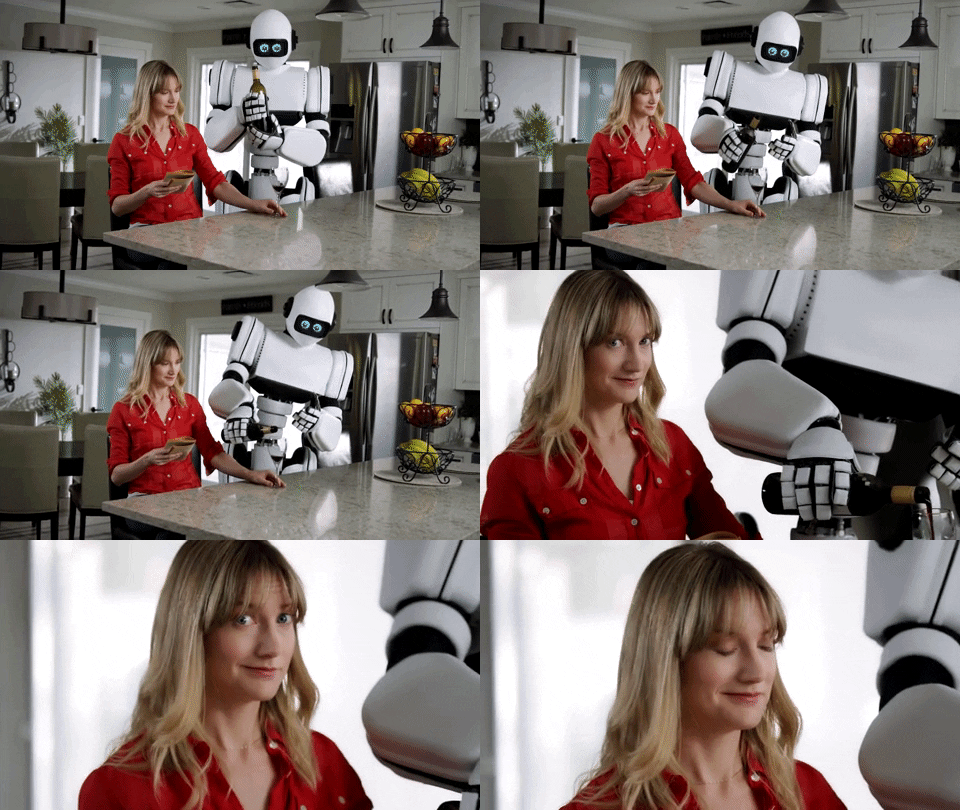
In the not too distant future – things could get even weirder. People developing serious relationships with humanoid robots – Robots which look, feel and act, just like humans. The vote 50 years from now might make gay marriage seem so minor as we vote on whether or not humans and robots can get married!

Happy Valentines Day.