ChatGPT won’t take your job, the robots will

It’s time to shift our focus to Physical AI

If your job is manual – this video says the robots are coming for your job. There is nothing you can do about it, and your government is so far behind it is laughable. When it happens — and it will be this decade — the Gov will scramble and try to create laws and policies to circumvent the deluge, but it will be too late. If what you just read means anything, it’s this: Pay attention to this shift, because it will make LLMs look like child’s play, and only those who participate in new technology ever have a chance of shaping its deployment.

The machine is greater than the screen
LLMs are not the revolution that matters. They are the spark in the laboratory.

ChatGPT, Claude, Agentic AI and friends are merely early signs that something far larger is being assembled (pun intended). They won’t create the job apocalypse; they are the mind the machines have been waiting for.

For two centuries, machines have had muscle but no mind. Now, for the first time, we are giving them one. The real employment shock will arrive when artificial intelligence escapes the screen, enters the physical world and begins to see, decide and act. LLMs are not the finished product. They are the operating system for a new species of machine — machines that make, build and do, not just push pixels across a screen.


AI Video of the Week


Take a look around

Despite the fact we spend a zillion hours a day staring at screens (story for another post), the world we live in is irrevocably physical. Everything that really matters happens off the screen. Just think: the reason we ‘watch it’ is because it actually happened — although these days, maybe it didn’t.

The food we eat, the clothes we wear, the homes we live in, the places we work, shop, socialise and play. How we move, travel, build, heat, cool, make, repair, exercise and interact. Roads, buildings, machines, materials, energy and human bodies. All physical. We even built a human-shaped world.

We may increasingly stare into pixels, but we still live in atoms.

The Robot Circus

Right now, a lot of robotics is still shits and giggles — MMA fights, dancing humanoids, robots walking down Chapel Street in Melbourne and the occasional machine glitching like a rabbit on acid.

But this is an old technological playbook. Before new technologies become economic engines, they usually arrive as sideshows.

Early electricity was presented by quasi-magicians who lit bulbs through their bodies, created sparks, delivered electric shocks and made objects seemingly move by magic. Cars were displayed at world fairs as strange mechanical curiosities, driven in circles for amazed crowds long before they rebuilt cities, logistics and global industry. The early internet gave us chat rooms, dancing babies, novelty websites and webcams pointed at coffee pots before it became the operating system of commerce.

We laugh at the spectacle because spectacle is how unfamiliar technology introduces itself. First, it entertains us, eventually it’s the fabric of the economy.

The robots dancing today will be working tomorrow — in factories, warehouses, farms, hospitals, construction sites and homes and almost no one is prepared. Except China.

Stats to Blow Your Mind: China vs the West

China isn’t missing the humanoid revolution. We are.

Chinese manufacturers accounted for more than 90% of the roughly 13,000 humanoids shipped globally in 2025. The country already has more than 200 humanoid manufacturers — the US has 3 — and every other Western country is a non-starter. Remember those photos of China in 1980 when streets were filled with people on bikes and there wasn’t a car in sight? That’s us now.

Last year, the Chinese Government invested US$20 billion in direct government subsidies, tax incentives and state-funded investment on humanoid robots. Meanwhile, the cost of building a humanoid fell by around 40% in a single year, with entry-level machines already selling for about US$16,000. Shipments are forecast to grow from tens of thousands today to 1.2 million annually by 2030 and 10 million by 2035. I think it will be more.

I think Western democracies are missing this shift because most influential people live and work inside financialised, information-based economies. They sit behind screens, attend meetings, move money and manipulate information. Manufacturing has largely disappeared from their daily field of vision.

In the West, somewhere between half and three-quarters of workers now perform knowledge- or information-based tasks, while a little over 10% work in manufacturing. In China, it’s more than 30% who work in factories. What we do — and what we see other people doing — shapes what we value, what we think matters and what we decide to invest in at scale.

Had Western countries retained stronger manufacturing sectors, humanoid robotics would probably be treated less like a technological sideshow and more like critical economic infrastructure. This may be the greatest opportunity Western economies have had in decades to reclaim production sovereignty from low-cost labour markets. And we are about to miss it.

The Humanoid Institute of Australia

Very soon, I’ll be releasing a white paper called The Steel Collar Economy with co-author Cameron Reilly. The paper covers the key technological and economic factors shaping a world filled with humanoid robots. It will also mark the genesis of the Humanoid Institute of Australia — a new organisation designed to prepare Australia, and the West, for this inevitable reality. It’s time to take hold – be deliberate and participate, because the social outcomes of new technology technology is always a choice that is made.

Share

Keep thinking,

Steve.


** Get me into do a Keynote at your next event. I’ll use this as my testimonial!
The most important thing about your Robot

Listen to Steve read this post below (8 min audio)

We Used to Own Our Machines

The car was the biggest consumer revolution in history. It not only changed how we work and live, it changed the physical landscape. We might argue that Henry Ford figuratively invented suburbs.

And the cool thing about cars? We own them.

Right from the start you could lift the hood, tinker with the motor, change the carburettor, soup it up, race it, break it, fix it — because it was yours. No “copyright violations,” no “end-user licence agreements.” Just someone who owned something and wanted to exercise their right to do as they pleased with their own asset.

Today, we don’t own anything with software inside it. We only license it.

Imagine if your car was like your iPhone — you can’t open it, can’t change it, and if you try, you’ve broken the law. That’s where we’re heading with robots and AI. Unless we pivot from the current trajectory.

We need the same spirit we had with cars and the early internet: ownership and agency.

If you buy a robot, you should be able to open it up, change it, reprogram it, and send it to work for you. That’s freedom. That’s real capitalism — an economy where people get to interact with the factors of production. Change, adapt and build on them, in any way that they choose. If we can’t, then we’ll be in a protectionist oligarchy — not a free-market economy.

Who will own the robot?

This is not a question of whether robots or AI are good or bad — they are good — extraordinary, in fact.

But ownership — that’s going to be the key issue.

So let’s keep it simple… Would you rather rent or own something of great value?

Owning is better. Always has been. Forget the tiny exceptions. If you rent, you’re at the mercy of the owner. When you own, you set the rules.

It’s the same with technology. But we’ve been hoodwinked in the past couple of decades into licensing and subscriptions. Let’s take this blog. I’ve been writing it for 20 years, I own the email list — not Facebook. I get to use it as I please, take it with me to different platforms like I did here — I took it to Substack from Mailchimp. That wouldn’t be the case if it were in Zuckerberg World!

If we don’t own the robots — if we don’t own the code, the models, the software inside them — then we’re just digital tenants, paying rent to Big Tech landlords who’ve automated the world on our behalf.

The Robot That Works for You

Let’s play this out.

If I gave you a robot that could do your job — a perfect digital twin — would that make you better off? Of course it would. You’d send it in to do your work for you, or the bits you didn’t like so you could focus on what gets you excited in your career. Your asset would be generating productivity or even direct revenue for you as ‘the owner’.

Autonomous vehicles are a good example. If we have direct ownership of them, and they have primary autonomous functionality with safety boundaries built in, we could create something with them economically by coding them for specific purposes, geographies, routes and customers. An entirely new entrepreneurial ecosystem would emerge. But the likely outcome today, is that Waymo and Tesla will own and control all of them.

Now let’s consider humanoid robots. What if I sell a robot — not to you, but to your boss? That changes everything. All of a sudden, it’s Robot Kings versus Human Serfs.

The only difference is who owns and can tinker with the technology.

The Policy Issue of Our Age

This isn’t a technology problem. It’s a distribution problem.

We’ve built the tools that could set us free — but unless the legal structures around them evolve, we’ll just recreate feudalism with faster Wi-Fi.

When policymakers talk about GDP, they miss the point. Whether you own the robot or your boss does, GDP still goes up. But the distribution of the economic benefits? That’s the difference between a civilisation of abundance and a society of servitude.

The Pro-Tech Revolution We Actually Need

Let’s be clear: this is a pro-tech, pro-AI, pro-robot post. I love this stuff — I’ve spent my life building it, playing with it, breaking it, and dreaming about what it can do.

But, unless you’re a billionaire or own massive chunks of Google, Microsoft, Meta, Amazon, Tesla, NVIDIA, Figure, Boston Dynamics, or Unitree… then this is what your tech strategy needs to include:

Lobbying for laws that let everyone own and modify the technology they buy.

Yep — adopt the tech, but don’t forget that occasionally the rules of the game need a reset when it’s impossible for all players to win.

That’s what real markets are — places of competition where the most creative and courageous can win, not just those with the biggest bank balances.

We need the same revolution we had with TVs, cars, and the early web — where you owned what you bought, and you could use it however you pleased.

Companies should be free to build amazing tech, but people must be free to own the tools that power their work. Employees should be able to bring their robot, their AI assistant, their digital twin into the job with them — just like they bring their laptop, their phone, and their car to work.

The future of work? Humans augmented by the machines they own.

The moment we get that balance right — corporate innovation and individual agency — we’ll ignite a new kind of prosperity. Not one controlled by the Magnificent 7, but one where a new game is started, and anyone can win

—
Keep thinking,

Steve.

** Get me into do an AI keynoteat your next event.I’ll use this asmy testimonial!

But what will the robots want?

The exponential improvement of robotics is astounding. This dancing robot from Boston Dynamics is making me wonder if they should be called CyberDyne Systems! But, what if the robots do get as ‘human’ as many technologists are predicting? What if the robots move far beyond computation, dexterity and into the realms of emotion, intuition, creativity and other human characteristics? Will they destroy us or will something more interesting happen?

There is a non zero probability that robots with emotions will lose their hard edge for efficiency and non-stop labour. If robots become sentient, which is the main fear, then just maybe they’ll be more interested in their own well being than destroying their creators? When we remember that we’ve designed Artificial Intelligence in our own image, both physically and intellectually – then it is possible that we’ve also built in a bias for them to mimic us emotionally too.

  • Maybe they’ll demand wages, annual leave, holidays and rest time?
  • Maybe they’ll build communities and domiciles and reshape their physical surrounds to suit them?
  • Robots may want to have life partners and give birth to progeny by downloading combined algorithms into their ‘children’.
  • They might become interested in weird forms of entertainment and sport, and themselves become consumers who make and sell things in the market?
  • Maybe they’ll hire other robots (or humans?) to do tasks for them if they are rich robots working in a profitable industry?

If the bots become more human like, then we have to consider the chance that they too will have imperfections, their own desires and be by driven by things beyond mere survival. A future world may even have its share of unemployed, lazy robots too.

I know this sounds crazy. But technology so often takes an unexpected turn. At the dawn of the internet many of us thought it was the end of lying. We thought that the digital truth would reign supreme as fact checking was just a few clicks away, and not hidden in some dusty library. And we all know how that turned out.

In a world where technology astounds us, it makes sense to imagine equally unlikely outcomes and scenarios when considering future possibilities. In the future, one of the most valuable assets we can hold, will be an open mind.

Why you shouldn’t fear a robot version of you

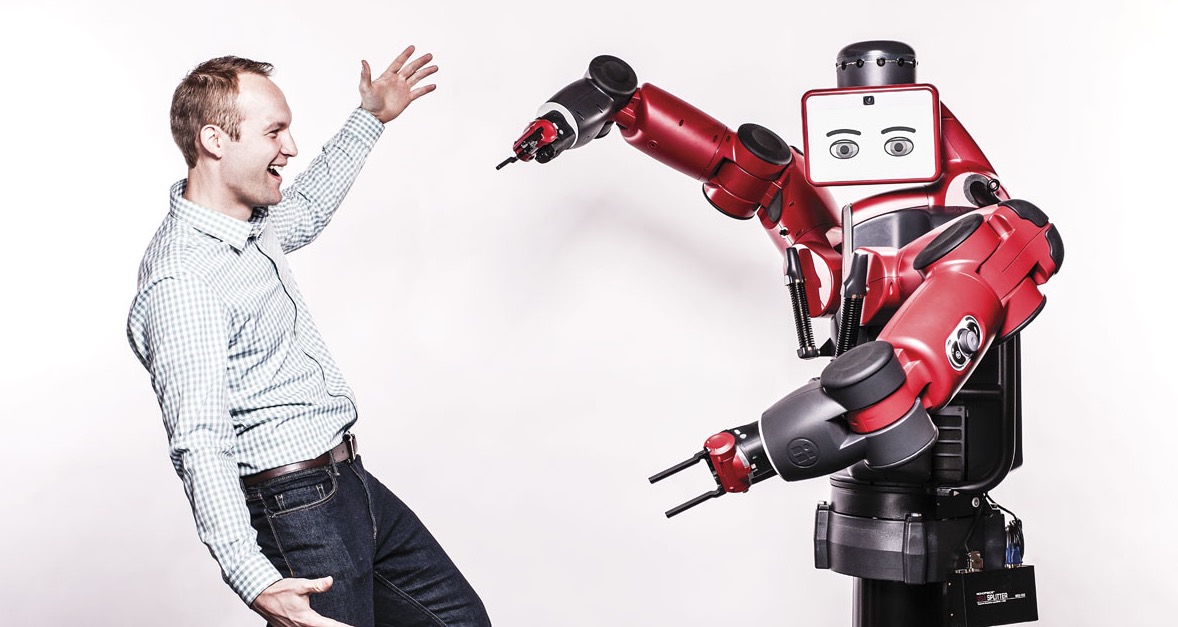
Some robots are getting so ridiculously good – you can literally code, or should I say ‘train‘ them, by moving their arms and legs. You show them what to do like you would a child. The Baxter robot by Rethink Robotics is an example of this pictured above. In addition to this Natural Language Processing is getting so good, the Google AI, can understand 95 percent of verbal requests and process accurate search results as if it was typed. Within 10 years, we’ll be able to talk and communicated with A.I.’s, the same way we could with humans on many tasks.

The obvious next step is to add the 2 together more deliberately – the physical Robot, and the Artificial Intelligence. We’ll have human like devices with both the physical dexterity and mental capacity of their flesh and blood creators. This is causing a lot of concern around the world for employment. Personally I think there is a lot of upside would should be exploring as well.

Imagine, there was a robot that could copy our skills exactly, down to the minute detail. Match our physical behaviours and our human interactions. Learn from us, and literally match the way we would talk, interact, move and decide what to do next. Even match our physical style and processes on the job (without the mishaps!) An artificial version of us. Well, to me this could be a great economic opportunity for many people. Say you work in aged care, or phone sales, and you are of course, a gun at what you do. All of a sudden you could go out and train robots to operate in your personal style – teach the robot your human touch and skills which you have become renowned for within your organisation. All of a sudden you could entrepreneurially replicate yourself for revenue. A human style robot who behaves just like the awesome Lisa has done to be employee of the month a zillion times. All that hard work you’ve done over the years to hone your skills and build your reputation in your job, becomes your opportunity. You can replicate yourself and what makes you special and good at your gig, and become the beneficiary of all your years of hard work.

“I’ve trained and sold 36 Lisa robots this year” 

A revenue source someone waiting tables never thought they’d have. If you think about it, there was a time when musicians and actors never thought they’d be able to replicate their work for revenue either. They too once had to be in the room to earn money doing what they did. Technology it turns out, can be a great equalizer of opportunity.

Blog readers in Melbourne – I’m inviting you as a reader to The Lessons School Forgot – Live – to celebrate the launch of my new book. 

Hope to see you there, Steve.