Enlightened Loyalty

Loyalty in life matters. But one thing we should never be loyal to, is a corporation.

Corporate loyalty is one of the most foolish decisions we can make, simply because companies, aren’t real. They are a legal-financial construct invented by humans to literally remove human oriented risk. And we can be sure that despite what they say, a company will never be loyal to anyone inside it. The ‘thing’ can only be loyal to its corporate objectives. It’s designed that way on purpose.

But here is what we can do – be loyal to the people we meet inside them. That has the potential to be enduring. This has the potential to extend beyond the original corporate meeting place because it is between people.

One of the most important decisions we can make – is what to be loyal to. On this my advice is simple, be loyal to people, not things or market based constructs. The irony of course, is that the more we focus on human loyalty, the more the companies and market places we inhabit benefit.

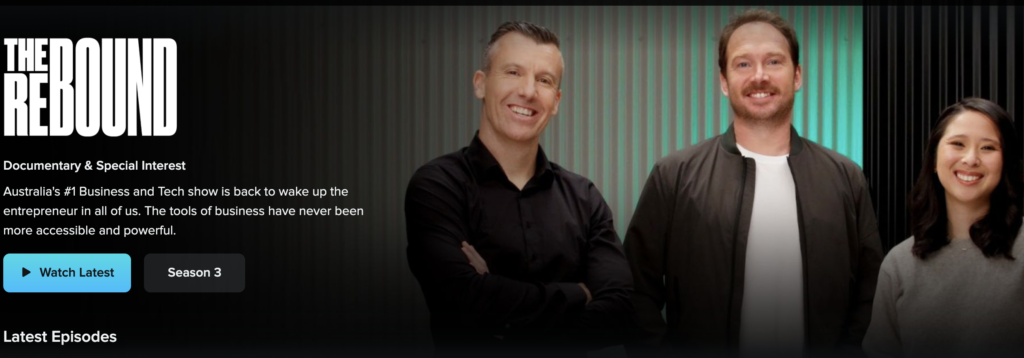
Speaking of loyalty – This weeks Episode of The Rebound is all about Gamification & Loyalty. It’ll be shown on Channel 9 Nationally at 12.30pm. We are now in our 3rd season which is pretty cool.

I remember the first pitch meeting we had with Channel 9. I said that we think smart Australians want to watch something a little more educational than seeing strangers get married on an island or at first site. A risky move, but it worked. I was loyal to what I actually believe. And when it comes to pitching I always say that the audience believes, what you believe They can smell it – and there is nothing more compelling than self belief. And while, we still haven’t cracked prime time our audience was up 61% across season 2. So thanks for all who are tuning in.

The first 2 episodes have already run. Ep.1 was all about Data and Algorithms – with clear explanations and hacks to get them working for you. Ep.2 was all about the Freelancer, something close to my heart because I am one.

And if you haven’t had enough Sammatron – here’s a radio interview I did for Talking Finance (nerdy I know) about why Elon Musk literally can’t afford to buy twitter. Yes, you read that right. The world’s richest human with his $250 billion+ in net worth, can’t raise the cash. Nearly all of his wealth is in Tesla Stock, and he hasn’t got the $43 billion in cash needed to buy it, and he can’t access it either. You can listen in here to find out why. I speak at 23 min mark- a simple insight into how investment markets really work.

I actually posted this interview about Elon Musk not having the money to takeover Twitter – and the tweeting Taliban descended upon me with hate mail. Lol. It’s an interesting example of misdirected loyalty. Elon’s fans, or should I say acolytes, think that he can do no wrong. No doubt he is a genius who has changed the world, but I think it is about time that we kibosh the idea that the person with the most money is always correct. Wisdom isn’t a financial construct, and neither should loyalty be.

– – –

Keep Thinking,

Steve

The Weirdness of Tech, Storytelling and Putin

The story you tell yourself determines your future.

Right now, horrible war crimes are being committed because of the story that Vladimir Putin has told himself. In his mind, he is a tzar who will reunify the old USSR, and will consequently go down in history as a great, powerful man. Though the validity of his story is questionable, we can be sure that the story he has told himself is the motivation behind the actions he has taken. Ultimately, it will define his future.

Stories are important. They are far more powerful than the truth. If we take a story to be true, then we’ll find ways to justify it, define it, and eventually act it out. As our minds think, eventually we become.

Now, let’s take the story of Elon Musk. No doubt – he is a genius, though he does act irrationally at times. He has certainly changed the world through electrifying transport and putting satellites into orbit. Musk has also made several stupid comments, accumulated US$40 million in fines for securities fraud and left in his wake a long list of broken promises, including putting 1 million robotaxis on the road by 2020. Today, he still can’t scale up to more than 750,000 cars a year, and there are exactly zero robotaxis on the road three years later. His promise of a Hyperloop is equally foolish when you realise he has basically rehashed an inferior version of a train.

But the Cult of Musk is stronger than the truth. Say a single negative word about him in any social forum, and his acolytes will attack you like a pack of wild dogs, accusing you of being a Luddite and not getting it. It doesn’t matter what the truth is. Musk’s story galvanises his fans with a real sense of religiosity. Recently I commented on a TikTok video featuring Musk proclaiming degrees are worthless and that you can learn anything without it. I agree – in many cases this is true. However, I made the mistake of posting a comment that I prefer my doctors to have medical degrees. I had 43 comments rain down on me that varied from accusing me of jealousy to claiming the entire medical industry is a scam. You should try it – click here and make a comment about an Elon tweet that doesn’t support his views, and you’ll see what I mean. There’s also a chance you’re reading this and thinking, ‘I thought Samma was into tech…. wow, I’m surprised’. Let me reiterate. I’m into science, humans flourishing and pointing out our foibles along the way. Storytelling is a powerful force that, like any technology, can be used to emancipate or fool people.

What’s most interesting is that it isn’t just individuals who can buy into a fantasy. We can have collective hallucinations. As I write this, the market value of Tesla is greater than the combined market value of the ten next biggest car companies. While Tesla had an early lead in EVs and autonomous vehicles, it’s now clear they have very little, if any, advantage. This is the financial value of story. I often say that Tesla is the world’s first trillion dollar story. If I had the choice to own either Tesla, or the ten next biggest companies that includes Ford, Toyota, GM, Daimler, BMW, Honda, and Volkswagen, I know what I’d choose. Without a question, it would be the ten auto manufacturers that collectively produce more than 50 million cars a year. The share market – which is meant to be a rational means of capital allocation – says Elon’s 705k annual production and ‘story’ is worth more.

Thought for the day: The story is always more profitable than the truth.

Now to you. What story do you tell yourself? The story of your capability, where you are going, and why you belong there? I tell my clients this all the time – they believe what you believe. The market looks to your story – the one you tell yourself first. By inference, this will the same story you are telling them, and often they put a value on that story.

Stories are what humanity buys into, simply because anything physical in nature starts as an idea or blueprint first. From building a house to putting a man on the moon. Our trajectory depends on our personal stories more than we give them credit for.

– – –

Keep Thinking,

Steve.

You’re Not Ready

A Marketing Director once told me, “You’re not ready yet, Steve. You need another 12 to 18 months in your current role.”

I took it in good faith. The conversation was regarding my filling a Marketing Manager role, a step up the corporate ladder from where I was. Then the next week, it was announced the person who was taking the job came from sales and had zero brand marketing experience. That was when I learned what the Marketing Director really meant.

“We don’t want to give it to you, Steve. We like this other bloke more…but we’ll tell you something digestible for now.”

Whenever anyone tells you that you aren’t ready yet, it can mean a lot of things – but it has nothing to do with being ready. Why’s that? Because no one is ever ready for anything.

Before anyone is given a chance to shine in a new role, there must be a leap of faith from someone, somewhere. Inside corporations, a great myth is perpetuated by managers that workers win their roles based on qualifications and experience alone. Mostly, managers give opportunities to the people they like, who went to the same school, follow the same football team, wear the right clothes. Someone not too different to them. It’s rarely about competence. If the game of corporate snakes and ladders were about competence, there’d be far fewer instances of CEOs pocketing $10 million to go away quietly because they did a terrible job. The corporate game is very different because what powers its success, the infrastructure, already exists. Most managers are simply riding it.

I haven’t been ready for any of the important milestones and projects I’ve done in my life. But I worked it out as I went along. Unless we are talking about something serious like flying a plane, engineering bridges or performing surgery, being ready is a corporate hoax. Ninety nine times out of a hundred, what needs to be learned can only happen once you are actually doing it. The mistakes we make literally becomes the readiness requirement.

When I built this with Raul, I had no idea what I was doing.

When I wrote my first book, The Great Fragmentation, I had never done that before.

When I wrote the first scripts for The Rebound and appeared on the TV screen, I wasn’t ready.

And now, I’m not ready to 3D print a house with Tom – but I’m doing it anyway.

I have never been ready for anything, and neither will you. So don’t believe them, and don’t wait for it. If someone tells you are not ready yet – it is time to leave.

Keep Thinking,

Steve.

Everyone will own NFTs

Art is just the start. By the end of this decade everyone reading this blog will own a large number of NFT’s. But they won’t be digital art, they’ll be part of a new combined commerce market where digital and physical properties permanently overlap and interact. But from now on it will serve you well to read the words ‘Smart Contract’ whenever you see the acronym NFT. Buckle in – we are about to get the missing link to the Internet we were promised in the mid 1990’s.

When it comes to market growth, NFTs are the clear winner of 2021. This year sales topped $A12.7 billion which represents a 2,500 per cent jump on 2020. These have largely been made via the Ethereum crypto currency and blockchain which, if anything, points to the importance of this crypto because it is “Turing Complete”. This means that the currency is actually programmable, like a computer. Bitcoin can’t do this. Ethereum will be the crypto which becomes the fabric that holds together the smart contract economy.

In 2021, Ethereum had a 700% increase from $US591 exactly one year ago, compared to Bitcoin which rose by, a still heady 266%. While the value of NFTs is crazy big, I can’t help but think that NFT sales wouldn’t be nearly as high if people were buying in fiat currency. Buying them in Crypto (Ether), must feel a little bit like spending ‘found money’ – especially if you’ve held the crypto for some time.

But let’s not let the NFT bubble (and it is a bubble), detract from the long game. The functional use cases for NFT’s which will emerge and change everything. I’ve listed below some use cases which are quite mainstream – to stimulate the mind on where this can, and will go. What we need to remember about NFT’s is that “Non-fungible” more or less means that it’s unique and can’t be replaced with something else. It serves a unique purpose and will in the future be programmed to automate in market transactions related to the NFT.

Property Rights: Your house title will be an NFT. It will state who owns (owned) the property, mortgage details, rates and other legal details. All people involved in a property: the owner, the financier and the Government will have access to data related to the property via private keys. This will reduce administration and costs and keep the details secure. Contracts for this property will automate payments between parties. Similarly, rental agreements will become NFT’s and data related to the rental including property conditions will be baked into the blockchain to avoid disputes.

Digital Identity: NFT’s will be used as a means for issuing important documents. Things like passports, driver’s licenses, IDs, health records, education credentials and the like, could all be tokenized and get their digital representation in the form of NFTs. Doing so would allow the authorities to check the validity of the document by seeing whether or not it is connected to an official NFT. With this, forged passports and IDs would be practically extinct, which would likely lead to a major disruption of all kinds of criminal activities around the world.

Events: Many consumer goods we purchase in the future will have NFT’s attached to them which give us access to events. Buying the latest album from your favourite performer may include an NFT which automatically gives you concert tickets in the front row., or even a back stage pass. All sold for a premium to super fans, or early adopters, or even speculators! Buying a this years premier league jersey of your club might entitle you to a seasons ticket to each game. Or a haute coutere dress could get you into an exclusive fashion show. It could even get more interesting than that – imagine an NFT becoming shares in a concert where the NFT owners underwrite the cost for Drake’s next world tour and those who buy the NFT’s share in the profit. All of this is possible.

Loyalty: The simple and classic example is frequent flyer miles. In many ways this system already operates much like NFT’s can. But, in the future there will be a market where we can trade our loyalty. I currently have more than 1 million frequent flyer points (sad I know) – I can’t use them all – in an NFT market place I might be able to sell 100,000 points to someone who wants to fly business class to London and receive $5000 for it. The buyer might get the flight and half the price and I’ve made some cash. It will be game changing technology for brands and loyalty.

Subscriptions: In this realm subscriptions can go well beyond streaming services and online news. Imagine a subscription coming with your next new car. Not only do you get the car – but you get access to certain ride sharing services simply by using your NFT. A car won’t just be a car – it will be a mobility service.

It’s Tricky: NFT’s will really shake up how intellectual property and contract law works the world over. The Hollywood studio Miramax recently filed a lawsuit accusing the director Quentin Tarantino for copyright infringement for his plans to sell NFT’s based on the screenplay for his 1994 movie “Pulp Fiction.” Tarantino’s NFT’s include a collection of seven uncut “Pulp Fiction” scenes as secret NFT’s, meaning their content would be hidden except to the owner. The content includes the first handwritten scripts of “Pulp Fiction” and commentary from Mr. Tarantino “revealing secrets about the film and its creator,” according to the release. Miramax contended it had certain “broad rights” to “Pulp Fiction” because the director had “granted and assigned nearly all of his rights” to Miramax in 1993. It will be interesting to see how this and cases like it, get resolved.

The Future: The reality is that buying anything physical can should come with a digital token (NFT). Even if it is unknown how the token might be used in the future, smart companies should start adding them their product portfolio now. The functionality can be added later. Likewise, anyone selling digital or virtual goods should be adding NFT’s, which at some point could get something physical added to it.

My advice is simple, pay attention to this space. Experiment and be the seller. Most of what is being bought today will be worthless tomorrow, but those who seize the real smart contract opportunity could invent something which changes industires.

– – –

Keep Thinking,

Steve.

Programmable Currency is coming

China’s 2021 crackdown on crypto currencies has continued unabated. They’ve now banned all types of Crypto transactions. But don’t be mistaken, China wants nothing more than to move to a crypto economy. The Digital Yuan – their own Crypto.

Currency Creates Control

It is said that you need control the three M’s to capture and control a society. The Media, the Military and the Money. The loss of control of any of these elements can lead to destabilisation of a Government. China is clearly intent on having a firm grip on all three. I’m with China on this one. Any government in the world that moves to a non-sovereign currency (Like El Salvador has making Bitcoin its national currency), will lose control of its economy. That’s not to say we shouldn’t have crypto – just Government issued Crypto. And the reason is simple – crypto currency technology, has many features fiat currency does not. While we may not like China’s policies and record when it comes to human rights – they are out performing other global powers when it comes to economic and geo-political strategy.

The Birth of Programmable Currency

One of the main features of blockchain based crypto currencies is their potential to be digital, yet anonymous. They key word here is potential, because the direct opposite can also be true. The Digital Yuan features what is known as ‘Controllable Anonymity’ given that it will require citizens to register and download the central bank app on their smartphone. But it doesn’t end there. The currency will literally be programmable. The China Government will be able to not only ‘air drop‘ money into people’s accounts, but they will have the ability to easily freeze and close accounts – something which can’t be done with, let’s call them ‘democratic’ crypto currencies.

This is where the move to the Digital Yuan gets interesting. They won’t just be able to control their currency distribution digitally, they’ll also be able to define where and when it can be spent. It will enable China to have a level of control over their monetary system not seen in the history of currency. Transfer payments will take on an entirely new meaning. When economic stimulus is required, they’ll be able to set expiration dates on money transferred to ensure it is injected into the economy and not saved. If it is not spent by a certain date it will literally evaporate from people’s digital wallets. They’ll be able to dictate where certain amounts money can be spent. Grants for students or unemployment may only be able to be spent on groceries, rent and transport for example. If a wallet is presented for payment to an unauthorised type of vendor, the transaction will be declined. They’ll be able to shape spending and investment in a way the global economy has never seen. It will give them an inordinate economic advantage on a global scale. And while it does sound slightly dystopian, it is clearly aligned to all their other economic policies we’ve seen recently as they tighten their grip on their ever-wealthier populace.

Non-Fungible Currency

While it’s not my hope that Australia moves over to a system like this in totality – a more democratic version of programmable currency is an incredibly powerful idea. Countries like Australia and the USA could create incredible productivity via programmable currencies.

Let’s take Job keeper. As published via the independent Parliamentary Budget Office’s analysis –the Morrison government paid $12.5 billion of JobKeeper in the scheme’s first 13 weeks to firms that didn’t experience the turnover declines they forecast in order to qualify for it. Extrapolated to the full 26 weeks of JobKeeper 1.0, that amounts to $25 billion of taxpayers’ money misspent. Around $9 billion was paid to firms whose turnover not only failed to decline as forecast, but actually increased.

This overspend could have been avoided if we could code into the money that it could only be used in wages and salary. We could also remove amounts from their accounts post-hoc once it was clear the firm didn’t face a decline. We could also make sure jobseeker benefits have restrictions on where funds can be spent, which protect the sanctity of the system. We could direct future stimulus payments into preferred economic sectors.

In the future, we’ll all have crypto wallets with two balances – money we can spend as we choose, and restricted funds. The eventual upside is that we’ll enter a pre-emptive tax code – a code where money is directed before it is collected. We won’t re-allocate money after it’s earned, but pre-determine where it can go. This will be something corporations will be able to do with their employees and spending budgets, no purchase will order would be required when money can be programmed on where it can be spent in the first instance. Even parents will be able to use this with their children – restricted handouts if you will.

This fundamentally changes what currencies can do and are. It’s clear that this is a big shift – and it won’t suit everyone, but it is my belief that most economies around the globe will move to Sovereign Cryptos (AU-c / US-c) and remove cash entirely from the economy within the 2020’s.

When this happens, we can also expect traditional cryptos to take the place of cash – and be the bastion of the hidden economy and dark money, and tradies doing crypto cash jobs – humans always find a way to hack any system!

Having money which isn’t fungible really marries up with the shift to increased control and autocracy the world over. What we need to ensure is that this shift doesn’t leak into the free market and remains a tool for more efficient Government resource allocation.

– – –

Keep Thinking,

Steve.

NFT to TV Star

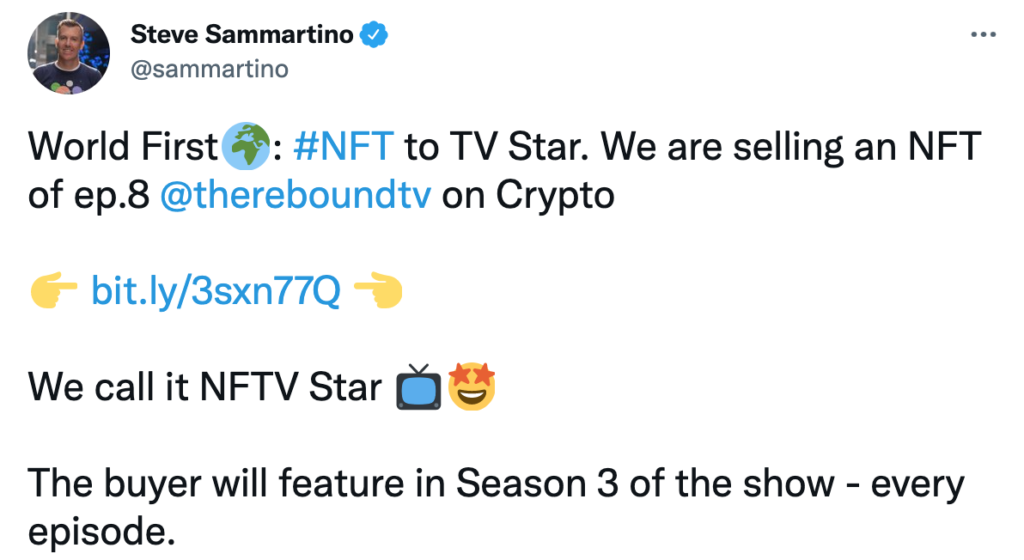
So here it is: my latest world first! As part of The Rebound TV show, we are selling the final episode of Series Two as an NFT. This is the first ever Australian TV show to be sold as an NFT.

Here’s the kicker: The winning bidder of this NFT will also become part of the next series of The Rebound. We call it NFT to TV Star! We will mentor them in their business or career, as part of the Accelerator programme on Series Three and broadcast nationally in Australia. This NFT will be someone’s ticket to TV stardom and a new financial trajectory.

You can buy this NFT on Rarible.com – check out the NFT here. Heck, why not bid on it? At the time of writing, it’s a mere 10% of 1 Ether (around $323 USD). I’d love to have one of my readers win it and come on the show – that’d be rad.

As you may know, NFTs are tokens of digital assets. The cool part is that you can attach other entitlements to these tokens – all of which are verifiable on the Ethereum blockchain. In this case, the buyer wins the token to our Crypto episode, as well as the right to actually appear on the show. But it doesn’t end there. The person who buys it can sell the NFT to someone else, or even a company looking to promote their business (a TV show would be a pretty good place to do that). So the NFT could also become a traded asset that increases in value before a smart contract is executed against it.

Bonus: You can buy this experimental NFT gif here. It also comes with an hour long mentoring session from me or Tommy. I have already sold four of these this week. Only one is left! I have listed it at a very reasonable price of 0.01 Ether (around $30, the minimum listing price). It’s a good way to dip your toe in the water to experiment with the tech and learn – which is what I did. Get on it and chat NFT / future stuff with me!

This is a nice example of how we can better use digital assets by attaching real physical things and future contracts to them. The world is getting increasingly meta. This means the most important asset isn’t the technology itself, but how we apply our imagination to it.

Keep Thinking,

Steve.

– – –

Surfing into the Future

There is almost no industry this technology revolution doesn’t touch – its impact is everywhere. How could anyone ever keep up with such broad and rapid change? Answer: no one can. But what we can do is understand the pattern of the changes, be in tune with enough of the shift that when something new arrives, we can get across it quickly. The best hack to do this is to leverage what you love.

Rather than trying to study all the emerging technologies on their own merits, assess them in the context of something you are totally into. While technology is reshaping industry, it has a similar effect on what we do in our free time as well. It could be your favourite sport, hobby or passion. For me, that happens to be surfing. I’m always using the lens of a surfer to experiment with and understand emerging tools, behaviours and business models – which I then relate back to my work as a futurist.

Some of the ways I’ve used surfing to gather tech knowledge include:

  • Building Sneaky Surf, an iPhone app. This tool tracked surf sessions, created social groups and integrated surf reports from weather APIs.
  • I learned to fly drones and understand their capability while making videos of my buddies surfing. This led to me working with the federal government to design new drone regulations for the AIS.
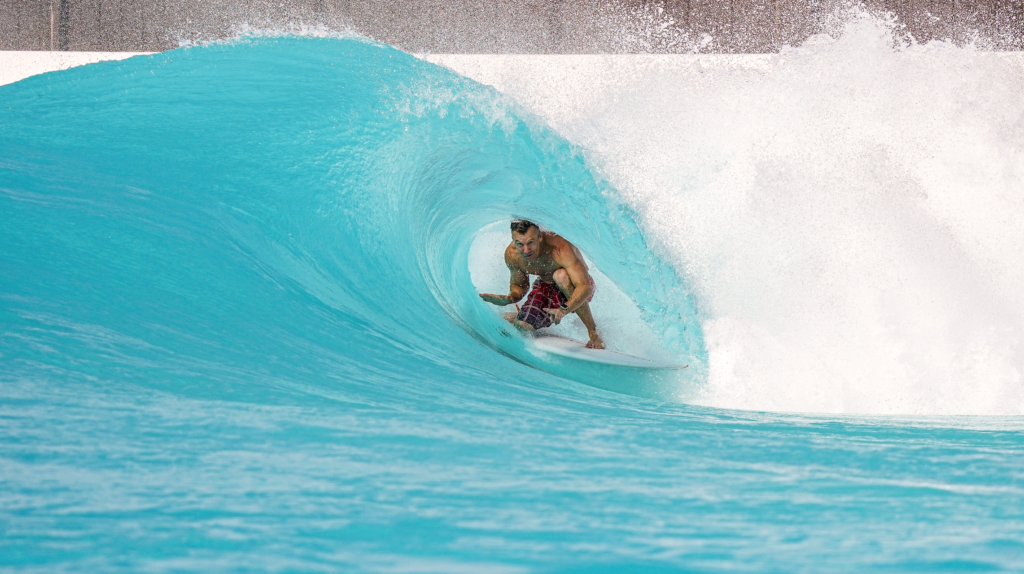
  • I used 3D printers to print experimental fins for my surfboards. Now I’m working on printing a stronger surfboard capable of withstanding the pressures of Melbourne’s new concrete wave pool. (Yes, that’s me in the picture above – YEW!)
  • I’m now working with UrbnSurf wave pool to run events demonstrating what businesses can learn about innovation through surfing. (Without artificial intelligence, the current wave pool boom would remain merely the stuff of childhood fantasies.)

In addition to my own little projects, I take a keen interest in the surf industry and how it is struggling to evolve its business model from a retail and brand perspective. Consider UrbnSurf or SurfLakes. Wave pool innovations really should have sprung from the surf industry giants like Quiksilver, Billabong and Rip Curl. I study the media implications of the World Championship Surf tour whose profile has evolved from a few highlights on weekend sports TV shows to being its own bonafide media empire. Innovations in surfing also include the impact of materials science on wetsuit design and how we can use tools like Google Earth to discover world class waves no one has ever ridden. Of course, the list is much longer, but you get the idea. All these tech knowledge hacks didn’t feel a bit like work and kept me at the beachhead of what’s next.

You too can transfer this principle into your passion and know more than just about anyone in your industry on emerging tech. Maybe even get a few tax deductions along the way!

While this post is mostly about hacking your own mind to learn and help your career, it’s about unlocking the power of our passions. While some people say it’s dangerous to mix up work and pleasure, I say we should never under estimate how much we cross-fertilise what you do for fun and turn it into funds.

– – –

Keep Thinking,

Steve.